
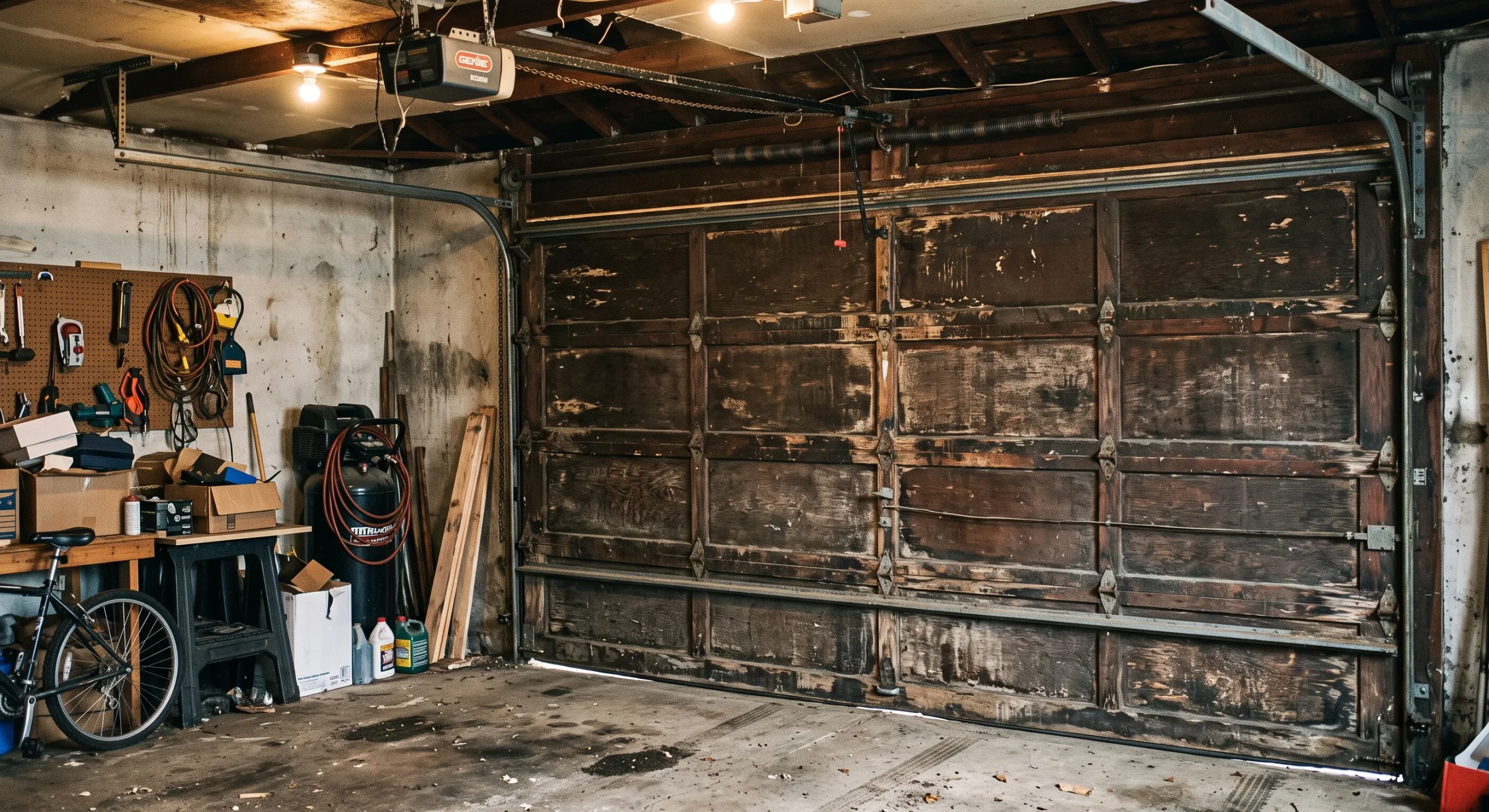
A garage door that is starting to show its age rarely fails without giving some warning first. The sounds change. The movement gets a little slower or less smooth. Something looks slightly off. Most homeowners notice these things, make a mental note, and move on without taking action. It is easy to do, especially when the door is still technically working.
The problem is that garage door warning signs do not stay small. What starts as a minor noise or a slightly uneven movement is almost always a symptom of something that is actively getting worse. Every day the door operates in that condition, the underlying issue develops further, and the repair that could have been simple becomes something considerably more involved. In some cases, the damage accumulates to the point where garage door replacement becomes the only practical path forward.
How Small Warning Signs Turn Into Big Problems
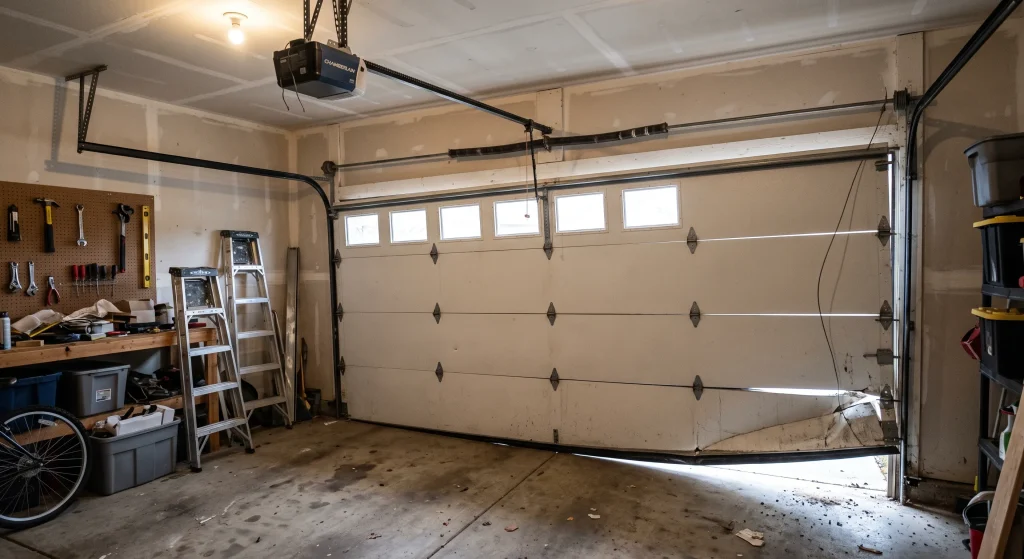
Garage door systems are made up of components that work together under tension, load, and constant mechanical stress. When one part begins to wear or fail, the rest of the system compensates, and that compensation creates new points of stress elsewhere. The result is a pattern where one ignored problem almost always creates a second, and often a third.
The Chain Reaction of Mechanical Failure
Understanding how garage door problems compound helps explain why acting on early warning signs is so much more cost-effective than waiting until something stops working entirely.
- A worn roller that creates uneven movement puts extra lateral stress on the track, which can cause the track to bend or pull away from the wall mounting over time.
- A spring that is losing tension forces the opener motor to carry more load than it was designed for, which accelerates motor wear and can lead to complete opener failure.
- A fraying cable that is not replaced continues to weaken with every cycle until it snaps, at which point the door can drop suddenly and without warning.
- Each of these scenarios starts with a sign that is noticeable and addressable early, but becomes a multi-component repair when left unattended.
Why the Door Continuing to Work Is Misleading
One of the most common reasons homeowners delay addressing warning signs is that the door is still opening and closing. This creates a false sense of security that leads to prolonged neglect of issues that are actively worsening.
- A door that opens unevenly is still technically functional, but every operation in that state is adding wear to rollers, cables, tracks, and the opener simultaneously.
- A door that makes grinding or scraping sounds is signaling friction or misalignment that is doing measurable damage with every cycle, even if the movement appears normal.
- Openers that strain or hesitate during operation are being pushed past their designed load capacity, which shortens their lifespan significantly with each use.
To understand the root causes behind why these components deteriorate in the first place, our guide on Why Do Garage Doors Wear Out Faster Than Expected? walks through every factor that accelerates wear on a garage door system.
The Safety Risks of an Unaddressed Garage Door
Beyond the financial consequences of ignoring warning signs, there are genuine safety risks that develop when a deteriorating garage door system continues to operate without attention. These risks affect everyone in the household, not just the person using the garage.
A Door That Can Fall Without Warning
A garage door that has compromised springs, frayed cables, or worn hardware is a door that can drop suddenly and unexpectedly. This is one of the most serious safety hazards associated with deferred garage door maintenance.
- A torsion spring that breaks without warning removes the counterbalance support that keeps the door from falling under its own weight.
- A snapped cable causes one side of the door to drop while the other remains supported, creating a diagonal fall that happens faster than a person can react.
- A door that falls on a vehicle causes significant structural damage. A door that falls while someone is underneath it is a serious injury risk.
- Households with children or pets are at heightened risk because children and animals do not always recognize the warning signs that something is wrong with the door.
Auto-Reverse and Safety Sensor Failures
Modern garage doors are equipped with auto-reverse mechanisms and safety sensors that stop and reverse the door if an obstruction is detected. When these systems are not functioning correctly, the door becomes dangerous to operate around people and vehicles.
- Safety sensors that are misaligned, dirty, or damaged may fail to detect an obstruction in the door’s path during closing.
- An auto-reverse mechanism that is out of adjustment may not respond quickly enough to prevent the door from closing on a vehicle, a pet, or a person.
- These safety systems require periodic testing and adjustment to remain reliable, and neglecting that maintenance creates a gap in the protection they are designed to provide.
According to resources covering all about garage doors, safety feature testing is one of the most commonly skipped maintenance steps among residential garage door owners, and one of the most important ones to keep current.
What Happens to Specific Components When Warning Signs Are Ignored
Each type of warning sign points to a specific part of the system that is under stress. Understanding what happens to those components when the warning is ignored makes the cost of inaction concrete and easier to weigh against the cost of acting early. For homeowners who have already gone through a garage door installation, recognizing these signs early is what protects that investment over time.
Springs That Are Left to Fail Completely
A spring that is showing signs of wear, making noise, or causing the door to feel heavy is a spring that is approaching the end of its service life. Continuing to use the door without addressing it accelerates that failure.
- A spring that breaks completely while the opener is running can damage the opener trolley, the drive mechanism, and, in some cases, the opener motor itself.
- On extension spring systems without safety cables, a broken spring can snap loose and travel across the garage at high speed, creating a serious projectile hazard.
- Replacing a spring that is showing early signs of wear is a straightforward job. Replacing a spring along with the opener components that were damaged on the way out is a significantly larger repair.
For homeowners who want to understand what drives the decision to replace rather than repair, our guide on When to Replace Garage Door: Signs It’s Time for an Upgrade covers that evaluation in full detail.
Tracks and Rollers Left in Poor Condition
Tracks and rollers that show signs of wear, misalignment, or debris buildup are often treated as low-priority issues because they do not cause an immediate failure. That perception changes quickly when the full consequences of leaving them unaddressed become apparent.
- A track that is slightly bent creates a point of resistance that the door must force through with every cycle, wearing down rollers, stressing panel joints, and straining the opener continuously.
- Rollers that have worn flat or cracked do not move smoothly in the track, which creates vibration and lateral force that gradually loosen the track mounting hardware from the wall.
- A track that has pulled away from its mounting is no longer guiding the door correctly, and a door that jumps the track during operation is an immediate safety emergency.
- Addressing track and roller issues when they first appear prevents what would otherwise be a minor maintenance task from becoming a structural repair.
Following garage door safety standards during routine maintenance checks ensures these components are evaluated correctly and that any developing issues are identified before they reach a critical point.
The Financial Cost of Delayed Action
Every ignored warning sign has a financial consequence that grows over time. The repair that costs a modest amount when caught early can multiply in cost as secondary damage accumulates. A routine garage door tune-up is often all it takes to catch those warning signs before they become costly repairs.
How Repair Costs Escalate With Delay
The relationship between time and repair cost on a garage door system is not linear. A small problem that is ignored does not just get slightly more expensive over time. It creates new problems that each carries its own repair cost.
- An opener that runs without adequate spring support for weeks will eventually need motor or drive replacement in addition to the spring work that was deferred.
- A door that operates with a misaligned track long enough will eventually damage the panels at the connection points, adding panel replacement to what would have been a simple track adjustment.
- Water intrusion from a deteriorated bottom seal that goes unaddressed will eventually cause rust on the lower panels and frame, requiring panel replacement or accelerating the timeline for a full door replacement.
- The cost of acting on a warning sign promptly is almost always a fraction of the cost of addressing the same sign after it has created secondary damage.
When Repair Is No Longer the Right Answer
There is a point in the deterioration of a garage door system where the accumulated damage makes replacement more practical than continued repair. Ignoring warning signs long enough can push a door past that threshold before the homeowner realizes it has happened.
- A door that has needed multiple repairs within a short period is showing that the system as a whole is failing, not just individual components.
- When the cost of the next garage door repair approaches or exceeds a meaningful percentage of a new door’s value, replacement becomes the more sensible investment.
- A full replacement at that stage also eliminates the ongoing uncertainty of operating a system that has already demonstrated a pattern of failure.
For homeowners evaluating what a replacement involves from a cost perspective, our guide on What Factors Affect the Cost of a New Garage Door? breaks down every variable clearly and helps set realistic expectations.
Do Not Wait for a Complete Failure to Take Action
Garage door warning signs exist for a reason. They are the system communicating that something needs attention before it reaches the point of no return. Acting on those signs early is almost always faster, less expensive, and less disruptive than waiting for a complete failure to force the issue.
If you are in Southlake, TX, and your garage door has been showing signs you have been putting off, First Responder Garage Doors diagnoses the full system, addresses the root cause of every warning sign, and restores safe and reliable operation before small issues become serious ones. Contact us or give us a call today and get ahead of the problem before it gets ahead of you.