

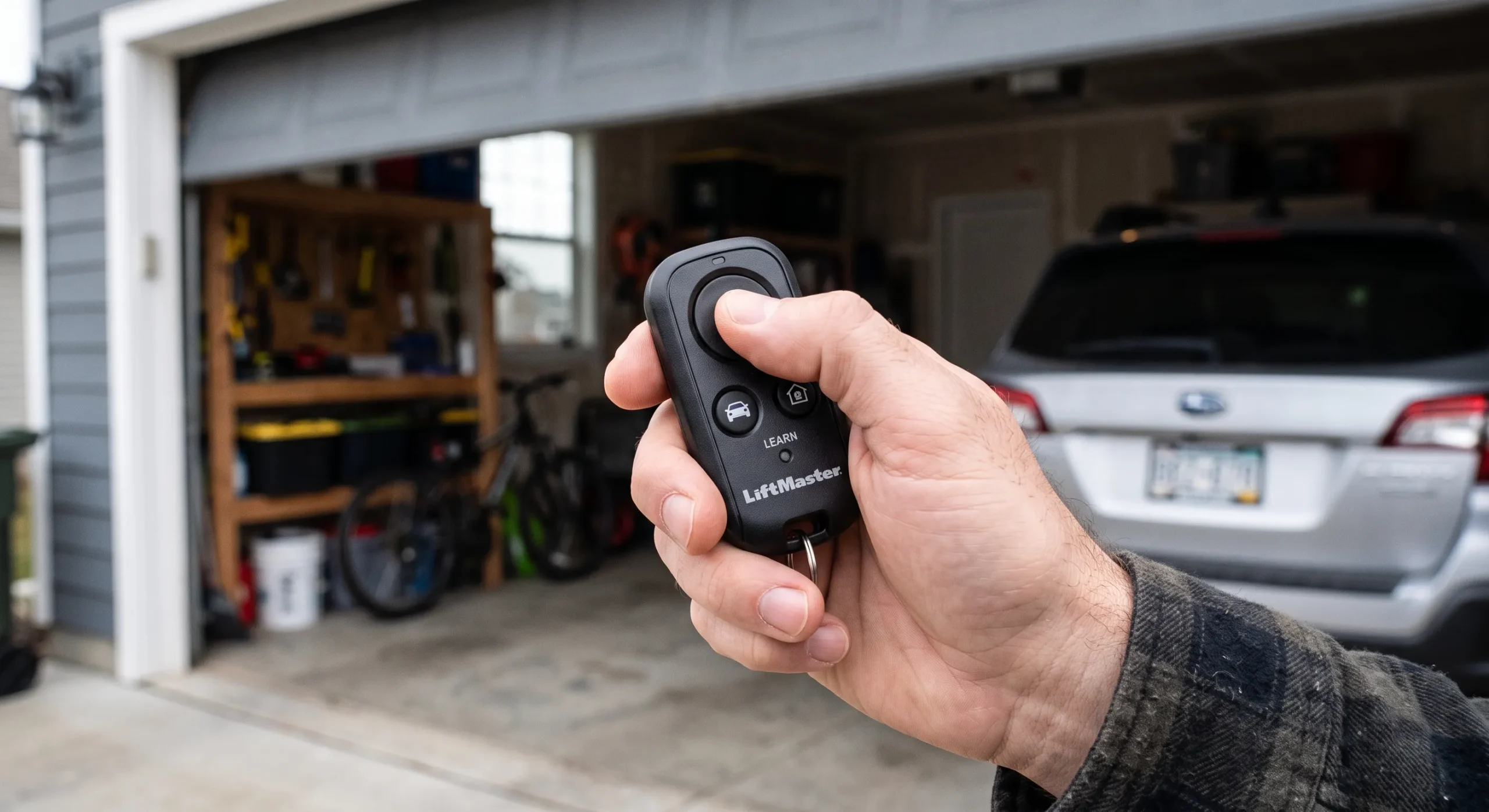
If your garage door remote works sometimes but not other times, the most common cause is a weak or corroded battery contact, followed closely by signal interference, misaligned photo-eye sensors, and opener logic board wear. Test the battery first, then check the sensors, since those two account for most garage door repair calls we handle for this issue throughout Southlake, TX.
Key Takeaways
- A remote that works “sometimes” almost always points to a specific, findable cause; it is not random.
- Weak batteries and dirty battery contacts are the single most common cause of intermittent failures.
- If the door won’t close intermittently but opens fine every time, check the photo-eye sensors first.
- Signal interference from nearby electronics can cause failures that come and go with time of day or weather.
- Opener logic boards and remote sync drift can cause failures that get worse over weeks or months.
- If more than one remote has started failing at the same time, the problem is almost always the opener.
- A routine garage door tune-up often catches battery, sensor, and wiring issues before they cause remote failures.
Recognize the Pattern First
Symptom Pattern | Most Likely Cause |
Works up close, weak or no signal from a distance | Weak or corroded battery |
Opens every time, closes only sometimes | Photo-eye sensor misalignment |
Failures tied to time of day or a new gadget nearby | Radio frequency interference |
Getting worse gradually over several weeks | Remote and opener sync drift |
Wall button inside is just as unreliable as the remote | Opener logic board wear |
Other remotes in the house work fine, only this one doesn’t | One remote failing among several |
Button feels mushy or needs an extra-hard press | Worn remote button contacts |
Weak or Corroded Remote Battery
A battery that’s running low often has just enough charge to work at close range, but not enough for a clean, consistent signal. This is the single most frequent cause behind an “it works sometimes” complaint, and it spikes every winter as cold mornings push weak batteries past the point of reliable performance.
How to Fix a Garage Door Remote With a Weak or Corroded Battery
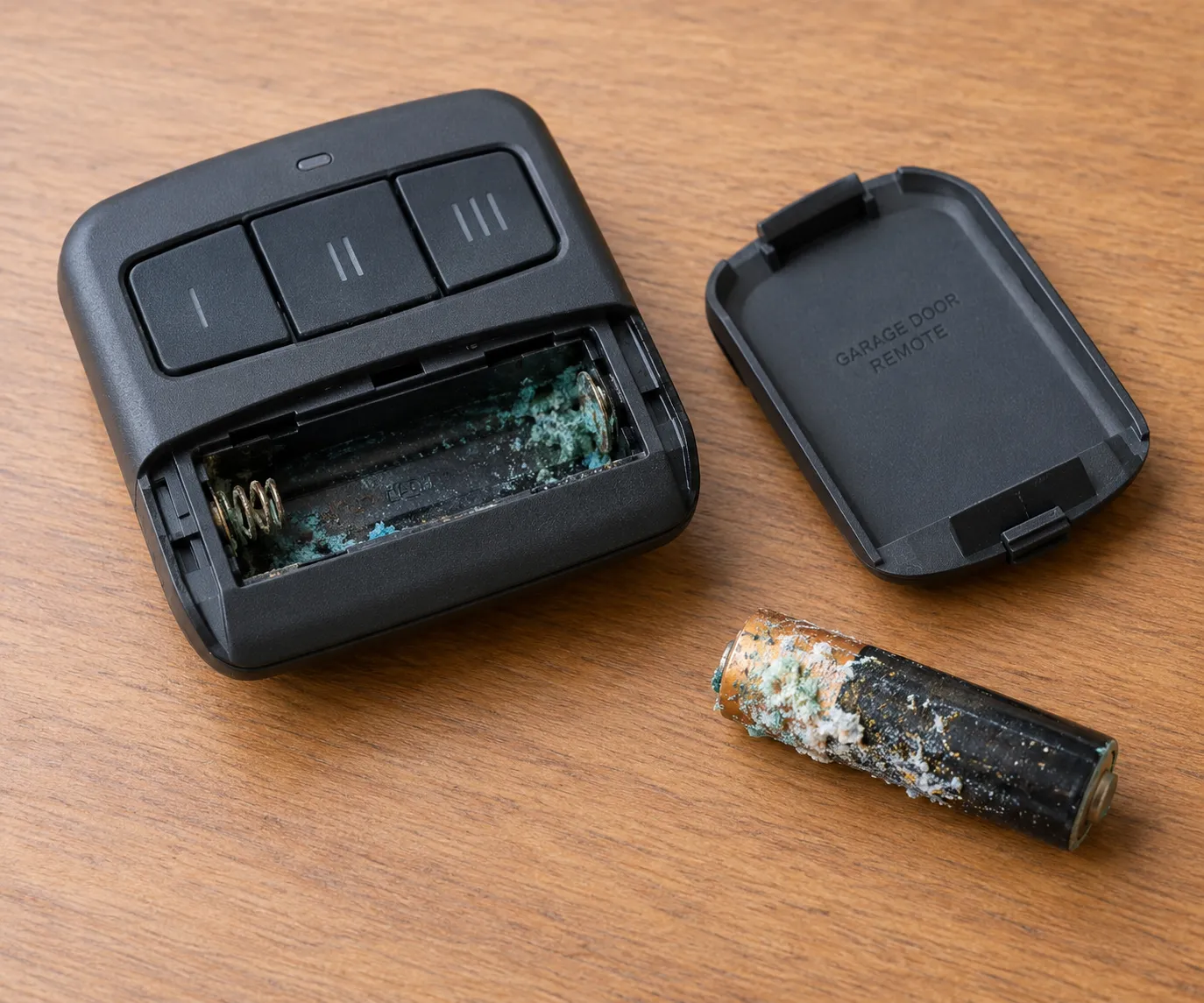
- Remove the battery and check for white or greenish corrosion on the contacts.
- Clean light corrosion with a dry cloth or a pencil eraser.
- Replace with a fresh battery of the correct type, usually a 3V lithium coin cell for keychain remotes.
- Press the button firmly and hold for a full second; weak batteries often need more contact time to register.
- Call a pro if the problem continues after a fresh battery, since that points to a different cause entirely.
Photo-Eye Sensor Misalignment
If your door opens fine every time but only closes some of the time, the photo-eye sensors near the bottom of the tracks are the most likely explanation. These sensors have to stay precisely aligned, and small bumps, vibration, or normal settling over time can knock them just far enough off to cause trouble that comes and goes.
If your door doesn’t close at all rather than working sometimes, that’s a more specific symptom worth its own read: Why Won’t My Garage Door Close With the Remote? 5 Sensor and Alignment Problems walks through that exact pattern in depth.
How to Fix a Garage Door That Won’t Close Intermittently Due to Sensor Misalignment
- Look for a solid, steady light on both sensors; colors vary by brand.
- Wipe both lenses clean with a soft, dry cloth; dust and cobwebs are a common culprit.
- Gently loosen and re-aim each sensor bracket until the lights line up and hold steady.
- Check that nothing is sitting in the sensor beam, a bike, a storage bin, or a stray leaf.
- Call a pro if the lights won’t hold steady after alignment, or the wiring looks damaged or chewed.
Radio Frequency Interference
Garage door remotes share radio frequency space with a growing number of household devices. If failures track with a certain time of day or a new gadget in the house, interference is worth ruling out before assuming the remote is failing.
If short range specifically, rather than intermittent failure, is the main symptom, Why Does My Garage Door Remote Only Work Up Close? 4 Signal and Range Fixes covers that pattern directly.
Why Does My Garage Door Remote Only Work Sometimes Due to Interference
- Note whether failures started after adding a new router, baby monitor, LED fixture, or solar inverter nearby.
- Try opening the door from just outside the garage instead of from the driveway or car.
- Move new electronics a few feet farther from the opener unit if possible.
- Test at a different time of day to see if the pattern shifts.
- Call a pro if interference is suspected, but the source can’t be identified, since a technician can test the opener’s frequency directly.
Remote and Opener Sync Drift
Some remotes and openers lose part of their programmed sync over time, especially after power outages or extended disuse. This shows up as a gradual decline rather than a sudden failure.
If you’re setting up a remote after a recent opener swap, read New Garage Door Opener, Old Remote Won’t Sync? 5 Fixes for Mismatched Systems.
How to Fix a Garage Door Remote That Slowly Stopped Working Reliably
- Check whether the problem has worsened over several weeks rather than appearing all at once.
- Re-program the remote to the opener following your model’s specific steps.
- Delete and re-add the remote in the opener’s memory if your model supports multiple stored codes.
- Test immediately after reprogramming, both up close and from a normal driving distance.
- For guidance on setting up a newly installed opener correctly the first time, Family Handyman’s walkthrough on installing garage door openers is a solid, practical reference to have on hand.
- Call a pro if the remote won’t hold its programming after two or more attempts, since this often points to a failing logic board.
Opener Logic Board Wear
The logic board inside the opener unit receives and processes the remote’s signal. As these boards age, they develop intermittent faults, most classically showing up as inconsistent response that has nothing to do with the remote itself.
How to Fix Intermittent Remote Failures Caused by an Aging Opener
- Note the age of the opener; units over 10 to 15 years old are the most common candidates.
- Check whether the wall-mounted control button inside the garage also behaves inconsistently; if it does, the fault is in the opener, not the remote.
- Watch for other odd behavior: flickering opener lights, random beeping, or the motor running without moving the door.
- The engineering standards that govern how these systems are built and rated are worth understanding if you’re comparing repair versus replacement; ULSE’s overview of automatic garage door standards explains why quality and safety ratings matter over the working life of an opener.
- Call a pro if the wall button is also unreliable, since this typically isn’t a DIY-level repair.
One Remote Failing Among Several
If one remote in the household is unreliable while others work fine every time, the issue is almost always isolated to that specific remote rather than the opener or the whole system.
Why Does Only One of My Garage Door Remotes Work Sometimes
- Compare the button response of the problem remote against a second remote at the same spot and time.
- Check that remote’s battery and contacts specifically.
- Look for physical wear: a soft or unresponsive button, a cracked case, or drop damage.
- Consider that remote’s age; older units wear out internally even with a good battery.
- Call a pro if a replacement remote of the correct brand and frequency still won’t hold sync.
Worn Remote Button Contacts
Even with a good battery, the button’s internal contact can wear down over years of use, creating a “sometimes it works” feel that’s mechanical, not electrical.
How to Fix a Garage Door Remote Button That Only Works Sometimes
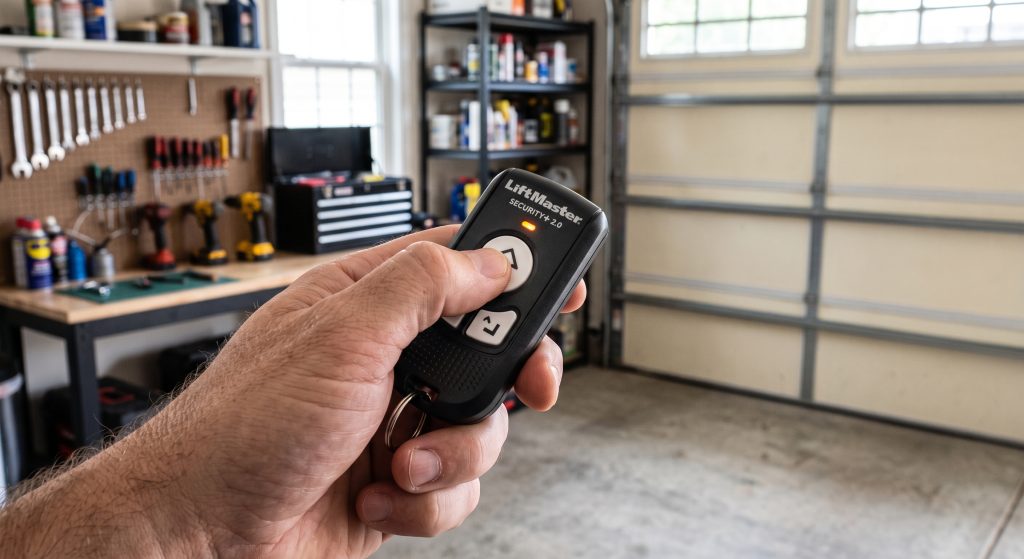
- Press firmly in the exact center of the button rather than the edge.
- Listen or feel for a distinct click, a mushy or silent press often means worn contacts.
- If the remote has more than one button wired to the same opener, test whether a different button works more reliably.
- Consider this cause if the remote is more than five years old and battery replacement didn’t help.
- Call a pro if the issue persists on a remote that’s out of warranty, since replacement is usually more reliable than repair at that point.
A safety note worth keeping in mind through all of the above: none of these fixes involve the garage door’s springs, cables, or opener wiring under load. If troubleshooting the remote leads you to suspect a spring, cable, or track problem instead, stop and call a professional. Those components store enough tension to cause serious injury if handled incorrectly.
Reliable Response Starts With Ruling Out the Obvious
Most “it works sometimes” remote problems trace back to one of two things: a weak battery or a misaligned sensor. Working through the causes above in order, starting with the cheapest to check, resolves most cases without a service call. When the pattern points toward the opener rather than the remote, that’s the moment to bring in a professional.
First Responder Garage Doors diagnoses and resolves intermittent remote and opener issues throughout the Southlake, TX area every week. If you’ve worked through this list and the problem is still there, contact us or give us a call to schedule a same-day diagnostic visit and get it solved for good.