

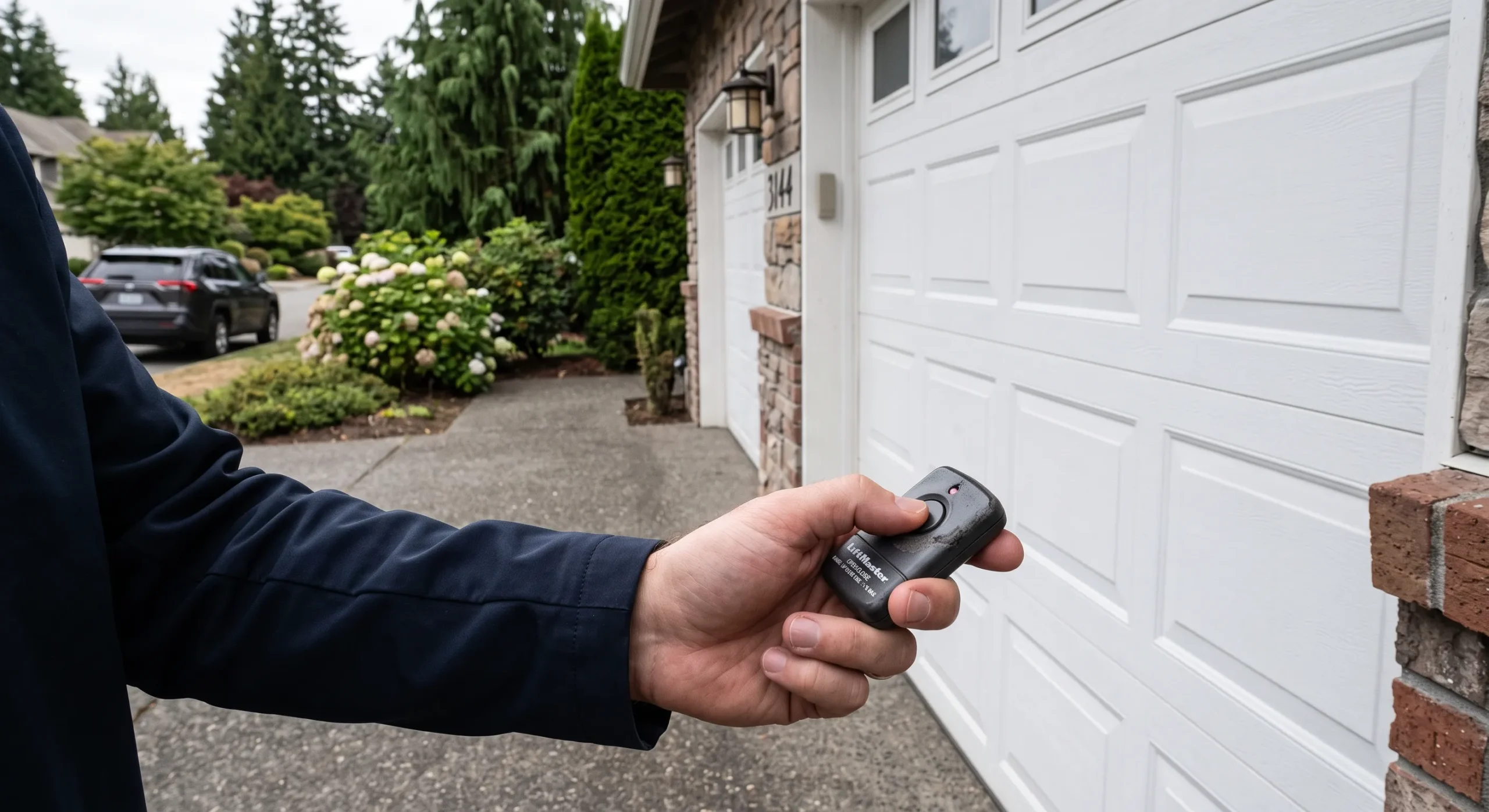
If your garage door remote only works when you’re standing right next to the door but not from the driveway or your car, the most likely cause is a weak battery, followed by antenna issues on the opener itself and interference from nearby electronics.
Range problems almost always trace back to a weak signal on one end of the connection, not a garage door repair issue with the remote itself, and most are simple to track down once you know the order to check them in.
Key Takeaways
- Short range is one of the clearest early signs of a weak or aging remote battery.
- The opener’s antenna, a thin wire hanging from the motor unit, plays a bigger role in range than most homeowners realize.
- Metal garage doors and metal building materials can naturally shorten remote range.
- New electronics, especially LED lighting and solar equipment, are an increasingly common cause of range complaints.
- If every remote in the household has short range at once, the problem is very likely the opener, not the remotes.
- Range problems are rarely urgent, but they’re worth fixing before a weak signal turns into no signal at all.
- A routine garage door tune-up can catch antenna and wiring issues that quietly shorten remote range over time.
How Long Each Fix Actually Takes
Cause | Time to Fix | Difficulty |
Weak battery | Under 5 minutes | Easy |
Antenna tucked away or damaged | 5 to 10 minutes | Easy to moderate |
Building materials blocking signal | Not fixable, diagnostic only | N/A |
Electronics interference | 10 to 15 minutes to test | Easy |
Weak or Aging Remote Battery
Range is one of the first things to suffer as a battery weakens, well before the remote stops working entirely. This makes range loss an early warning sign worth paying attention to rather than dismissing, since it’s the single most common cause of “it only works up close.” A remote’s transmitter needs a certain minimum voltage to push its signal far enough to reach the opener from a normal driving distance, and that threshold is higher than what’s needed for the remote to simply light up or click when pressed, which explains why a “half-working” remote often still seems fine at first glance.
How to Fix a Garage Door Remote With Short Range Due to a Weak Battery
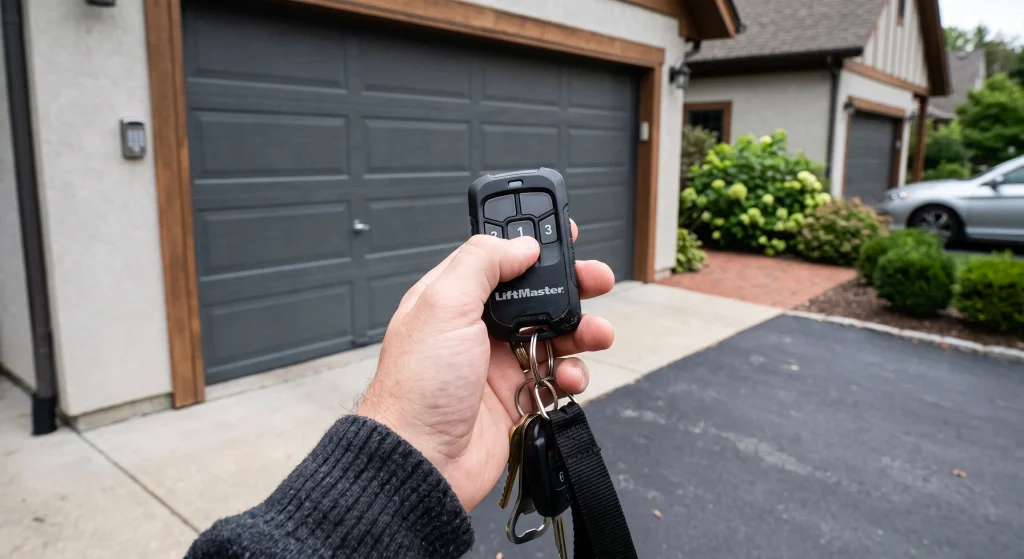
- Replace the battery with a fresh one of the correct type, even if the remote still works at close range.
- Test range immediately after replacement from your normal parking spot or driveway distance.
- If range improves significantly, the battery was the cause; no further action needed.
- Keep a spare battery of the correct type on hand, since this is by far the most frequent fix on this entire list.
- Call a pro if a fresh battery doesn’t improve range at all, since that points to a different cause entirely.
Damaged or Missing Opener Antenna
Every garage door opener has a small antenna, usually a thin wire hanging down from the motor unit, that receives the remote’s signal. If it’s been bumped, cut short, tucked up out of the way, or damaged, range can shrink dramatically without any other symptom showing up. Homeowners doing unrelated garage work, hanging storage, running new wiring, sometimes tuck the antenna aside without realizing what it does, and the range problem doesn’t show up until weeks later, long after the original work is finished and forgotten.
How to Fix Short Garage Door Remote Range Caused by the Opener’s Antenna
- Locate the antenna wire hanging from the opener motor housing.
- Check that it’s hanging freely and pointing downward, not coiled up, taped down, or tucked behind the unit.
- Gently straighten the antenna if it’s bent or tucked away, without pulling or forcing it.
- Retest range after repositioning to confirm the fix worked.
- Note the date if you recently did other garage work, since that timing often points straight to this cause.
- Call a pro if the antenna appears cut, broken, or missing entirely, since this typically requires a replacement part.
If the issue comes and goes rather than being a steady short range, Garage Door Remote Works Sometimes But Not Always? 7 Reasons for Intermittent Failures covers that broader pattern in more depth.
Building Materials Blocking the Signal
Metal garage doors, foil-backed insulation, and certain metal siding or roofing materials can all naturally weaken a remote’s signal, especially over the working life of the door as materials settle and surrounding structures change. This is a physics issue rather than a defect: radio waves lose strength passing through or reflecting off metal, and a garage is often surrounded by more of it than any other room in the house, from the door itself to the framing and any metal storage inside.
How to Improve Garage Door Remote Range Through Metal or Insulated Doors
- Note whether range has always been short or changed recently, longstanding short range often points to building materials rather than a new fault.
- Test the remote directly outside the garage versus from the street to gauge how much range loss is happening near the structure itself.
- Different door materials interact with radio signals differently, and Family Handyman’s overview of garage door types worth knowing is a useful primer on how those material choices play out in practice.
- Pay attention to whether range is worse on one side of the driveway than the other, since nearby metal fencing, siding, or a parked vehicle can add to the effect.
- Consider that little can be done to change building materials, but confirming this as the cause helps rule out a fixable fault being missed.
- Call a pro if you want to explore a signal booster or repeater option, since a technician can recommend compatible accessories for your specific opener.
If range issues appeared specifically after installing a new opener, rather than gradually over time, read New Garage Door Opener, Old Remote Won’t Sync? 5 Fixes for Mismatched Systems.
Interference From Nearby Electronics
A growing number of household devices, particularly LED light fixtures, solar inverters, and some routers, can interfere with the same radio frequency range used by garage door remotes, shortening effective range in ways that feel random until you spot the pattern. This cause has become noticeably more common in recent years simply because homes now contain far more wireless and electronic equipment than they did even a decade ago.
How to Fix Garage Door Remote Range Reduced by Signal Interference
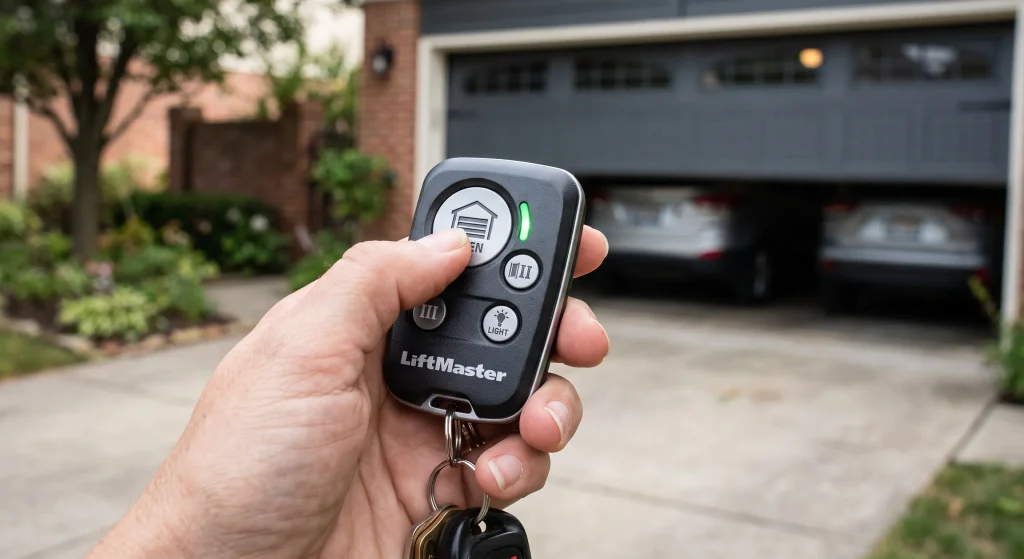
- Note whether range problems started after adding new LED bulbs, a solar system, or new networking equipment near the garage.
- Test range at a time when potentially interfering devices are off, if possible, to compare results.
- Consider relocating a new device a few feet farther from the opener if it’s a likely source.
- Keep in mind that interference tends to be inconsistent, so test more than once before ruling a device in or out.
- Call a pro if interference is suspected, but no clear source can be identified, since a technician can test frequencies and recommend next steps.
For a wider look at everyday troubleshooting beyond just range, The Spruce’s guide to common garage door problems covers several related issues worth knowing about.
If the door won’t close at all rather than simply having short range, Why Won’t My Garage Door Close With the Remote? 5 Sensor and Alignment Problems is the more relevant read.
Range Loss Rarely Means Your Remote Is Broken
Short remote range is rarely a sign of a failing remote on its own; it’s usually a weak battery, an out-of-position antenna, or interference that’s easy to identify once you know what to check. Working through these four causes in order resolves most range complaints without a service call, and often without spending a dollar. Because range tends to fade gradually rather than disappearing all at once, catching it early usually means an easier fix.
First Responder Garage Doors diagnoses range and signal issues, including antenna repair and booster recommendations, throughout the Southlake, TX area. If your remote still won’t reach from a normal distance after trying these steps, contact us or give us a call to schedule a service visit, and we’ll track down the cause.