

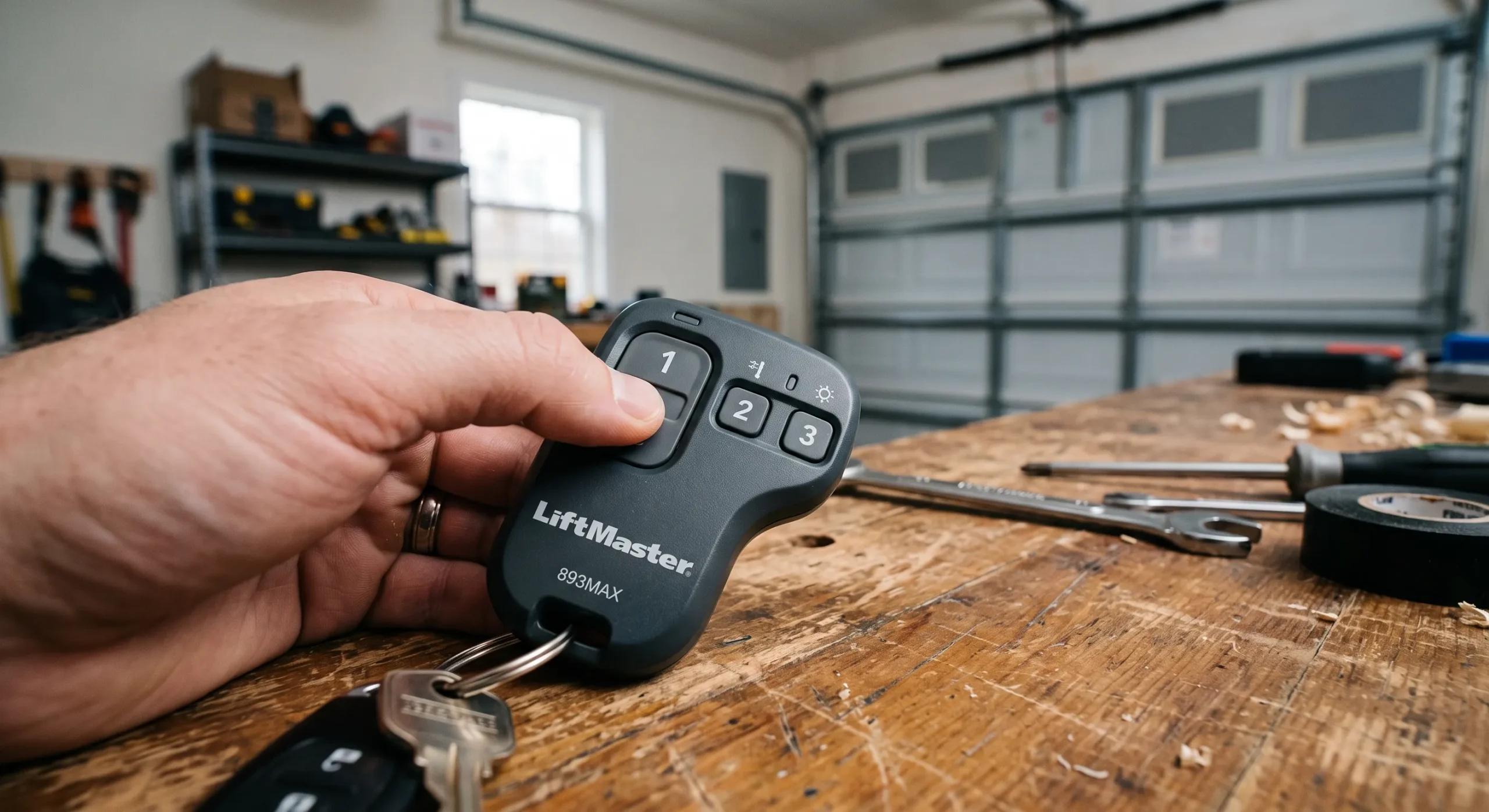
If your garage door opens fine with the remote but won’t close, or reverses partway through closing, the cause is almost always the photo-eye safety sensors near the bottom of the tracks. These sensors block the door from closing whenever their beam is broken or misaligned, which is a safety feature working correctly, not a malfunction, though it usually still needs a quick garage door repair fix.
Key Takeaways
- Opening works but closing doesn’t is a classic sensor symptom, not a remote or opener problem.
- A blinking opener light while attempting to close is often the opener’s way of signaling a sensor fault.
- Sensors can be misaligned by a fraction of an inch and still cause total closing failure.
- Direct sunlight hitting a sensor at certain times of day can cause a similar symptom.
- If the door reverses only partway through closing, timing and alignment are more likely than a full sensor failure.
- A seasonal garage door tune-up helps catch sensor misalignment before it turns into a total closing failure.
Work Through It in This Order
Step | Check This First | If It Still Won’t Close, Check Next |
1 | Sensor alignment, both lights steady | Lens cleanliness |
2 | Lens cleanliness and beam path | Sun angle at the time of day it fails |
3 | Sun angle at the time of day it fails | Wiring condition |
4 | Wiring condition, no fraying or looseness | Where in the cycle it reverses |
5 | Where in the cycle the door reverses | Time to call a professional |
Photo-Eye Sensors Out of Alignment
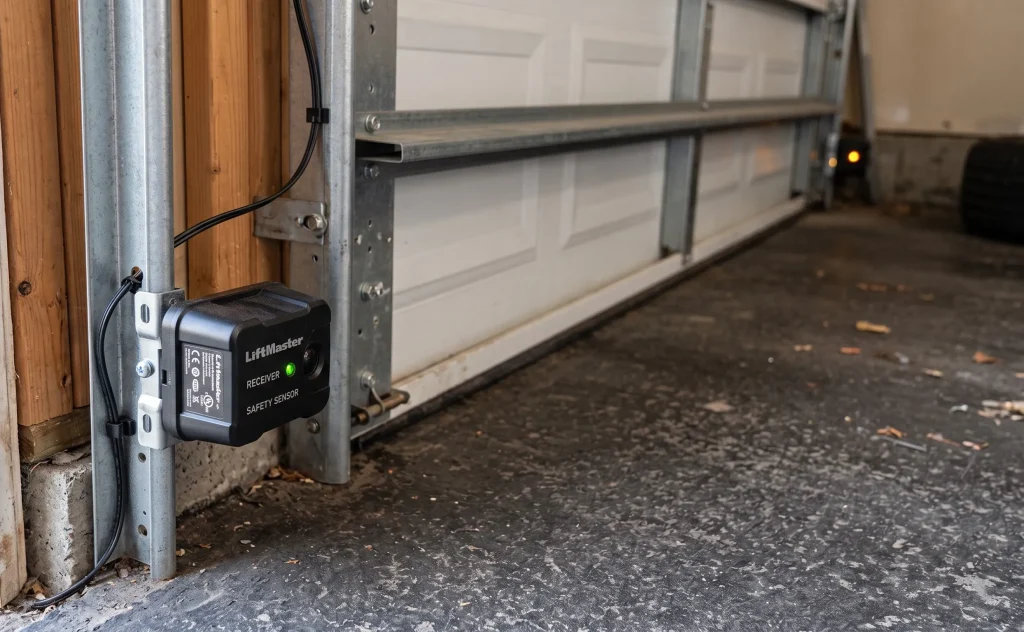
The two sensors mounted a few inches off the floor on each side of the door must aim directly at each other to complete their safety circuit. Even a slight bump from a car, ladder, or lawn equipment can knock one out of alignment just enough to break the beam without any visible sign of damage. Because the misalignment is often too small to see with the naked eye, it’s easy to assume the opener or remote is at fault when the sensors are actually the culprit.
How to Fix a Garage Door That Won’t Close Due to Misaligned Sensors
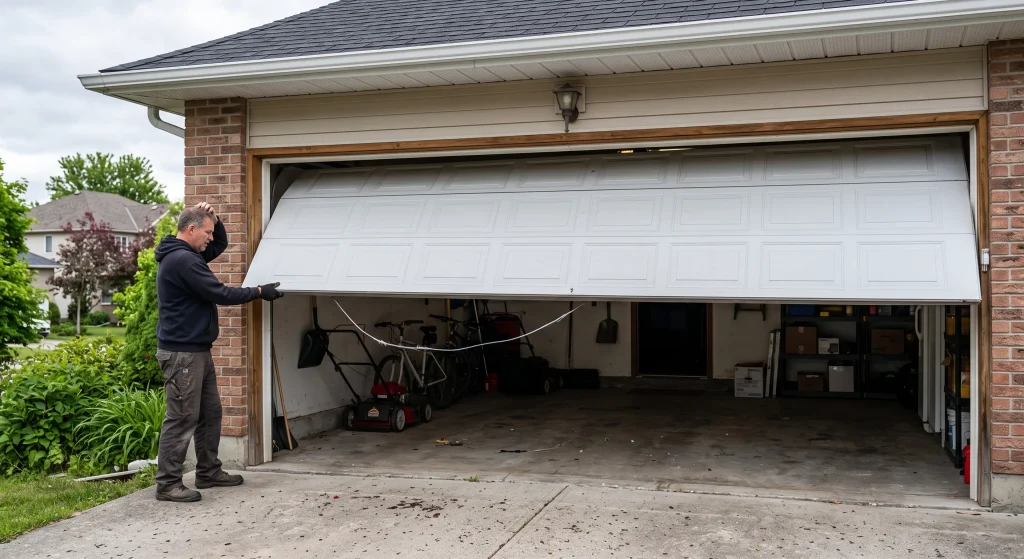
- Locate both sensors, typically small boxes on brackets near the bottom of each track.
- Check for a steady, solid indicator light on both units, colors vary by brand.
- If one light is off or flickering, gently loosen its mounting screw and adjust the angle until both lights hold steady.
- Retest by closing the door with the remote once alignment looks correct.
- Call a pro if the lights won’t hold steady no matter how carefully you adjust them, since the bracket itself may be bent.
Dirty or Obstructed Sensor Lenses
Dust, cobwebs, pollen, and even lawn clippings can build up on the sensor lenses over time, weakening or blocking the beam enough to prevent closing, even when the alignment itself is technically fine. Garages tend to collect this kind of buildup faster than most other parts of a home, especially near the floor where the sensors sit.
How to Fix a Garage Door Sensor Blocked by Dirt or Debris
- Wipe both sensor lenses with a soft, dry cloth, avoid glass cleaners that can leave a film.
- Check for spider webs or debris on the bracket itself, not just the lens.
- Clear anything sitting directly in the beam path, including stored items, toys, or a parked bike.
- Call a pro if the lenses are clean and the beam path is clear but the problem continues, since that points toward alignment or wiring instead.
Direct Sunlight Interfering With the Sensor
Strong, direct sunlight hitting a sensor’s lens at a low angle, common at sunrise or sunset depending on garage orientation, can overwhelm the receiving sensor and mimic a beam break even though nothing is actually blocking it. This cause is easy to miss because the door often closes fine the rest of the day, which makes the pattern feel inconsistent rather than pointing clearly to sunlight.
How to Fix a Garage Door Sensor That Only Fails at Certain Times of Day
- Note whether the closing failure happens mainly in early morning or late afternoon.
- Try closing the door at a different time of day as a test.
- If sunlight is confirmed as the cause, a simple sun shield or small hood over the affected sensor, available at most hardware stores, usually resolves it.
- Test this cause on a clear day versus an overcast one too, since cloud cover often makes the pattern easier to confirm.
- Call a pro if a sun shield doesn’t resolve the issue, since the underlying sensor may need repositioning.
If the remote itself behaves inconsistently across many situations, not just closing, Garage Door Remote Works Sometimes But Not Always? 7 Reasons for Intermittent Failures covers that broader pattern.
Loose or Damaged Sensor Wiring
The low-voltage wires running from each sensor back to the opener unit can loosen, corrode, or get chewed by pests over time, causing intermittent or total closing failure that looks like a sensor problem but is actually electrical. Garages that share space with rodents, whether occasionally or as a recurring issue, see this cause more often than most homeowners expect.
How to Fix a Garage Door Sensor With Wiring Problems
- Visually inspect the wire runs from each sensor back to the opener for fraying, chew marks, or disconnection.
- Check that wire connections at both the sensor and the opener terminal are snug.
- Avoid stapling or pinching wires when doing this inspection, loose is safer than damaged.
- General safety guidance for these systems is worth a look too; DASMA’s safety tips cover exactly why these sensors and their wiring matter so much.
- Call a pro if you find damaged wiring, since this involves working near the opener’s electrical terminals and is best handled by a technician.
If you’re dealing with a remote that won’t pair at all after a new opener install, rather than a closing problem, that’s a different issue, read New Garage Door Opener, Old Remote Won’t Sync? 5 Fixes for Mismatched Systems.
Door Reverses Partway Through Closing
If the door starts closing but reverses partway rather than failing to start at all, the cause is usually a sensor catching a beam break mid-cycle, or a close-force or travel-limit setting that’s slightly off from where it should be. This symptom tends to worry homeowners more than a simple no-close, since the door is already moving before something interrupts it.
How to Fix a Garage Door That Reverses Before Fully Closing
- Watch exactly where in the cycle the reversal happens, near the bottom is more likely a sensor issue, mid-travel may point to limit settings.
- Rule out sensor alignment and obstruction first, since these are more common than limit-setting issues.
- Avoid adjusting force or travel-limit settings yourself, since incorrect settings can create a genuine safety hazard.
- Ongoing professional care matters here too; IDA’s guidance on garage door care and maintenance outlines what a qualified technician checks during a routine visit.
- Call a pro if sensor alignment and cleaning don’t resolve a mid-cycle reversal, since this likely requires a professional limit-setting adjustment.
If the remote’s range feels short rather than the door failing to close, Why Does My Garage Door Remote Only Work Up Close? 4 Signal and Range Fixes is the more relevant read.
A safety note worth remembering through all of the above: the photo-eye sensors exist specifically to prevent the door from closing on a person, pet, or object. Never bypass, disconnect, or defeat these sensors to “fix” a closing problem, since doing so removes a critical safety feature entirely rather than solving anything.
A Sensor Issue Is the Best-Case Scenario Here
A garage door that opens but won’t close with the remote is one of the more reassuring problems to have, since it’s almost always a sensor issue rather than a deeper mechanical or electrical fault. Alignment and cleaning resolve the large majority of cases in just a few minutes, no tools or parts required, which makes this one of the few garage door problems most homeowners can fully solve on their own.
First Responder Garage Doors handles sensor alignment, wiring repair, and closing-cycle diagnostics throughout the Southlake, TX area. If you’ve worked through this list and the door still won’t close reliably, contact us or give us a call to schedule a service visit, and we’ll have it closing safely again the same day.