

Garage doors rely on many moving parts working in sync, but none matter more to smooth operation than the springs. Because they carry most of the door’s weight, the opener can raise and lower it without straining, which keeps everything moving the way it should. Over time, though, springs can weaken or snap, and once that happens, the door may start acting up in ways that range from minor to severe. You might notice something small, such as the door drifting out of balance, or you could face a full breakdown that leaves it unable to open at all.
Spotting these problems early makes a real difference, since small spring issues can turn into bigger system failures if they’re ignored. Knowing how the warning signs show up helps you decide whether the door needs a garage door spring adjustment or whether you’re dealing with a broken spring that calls for garage door repair. When failure is complete, professional help becomes urgent, because safe and reliable garage door maintenance depends on the right repair being handled correctly.
Garage Door Spring Adjustment: How Springs Keep the Door Balanced
The springs in a garage door system carry intense tension because they’re designed to counterbalance a door that can weigh hundreds of pounds. With the tension set correctly, the door feels surprisingly light as it moves along the track, rising and lowering without dragging or jolting. It should also hold its position when opened partway, which happens only when spring force and gravity are evenly matched rather than one overpowering the other. Balance, in other words, isn’t a bonus feature of the system; it’s the result of spring tension being tuned to the door’s exact weight.
That tension doesn’t stay perfect forever, though, because daily use and shifting weather gradually change how the springs behave. At first, the clues can be subtle: the door may feel heavier in your hands, refuse to stay open at mid-height, or drop faster than it used to. Each of these signs points to the same underlying issues that are no longer supporting the door the way they should. Recognizing that these changes are tied to balance makes it easier to spot spring trouble early, regardless of which type of spring your door uses.
For more clarity on when to bring in expert help, check out “What Are the Signs You Need a Professional Garage Door Spring Adjustment?”
Garage Door Torsion Spring vs Garage Door Extension Springs: How Each Works
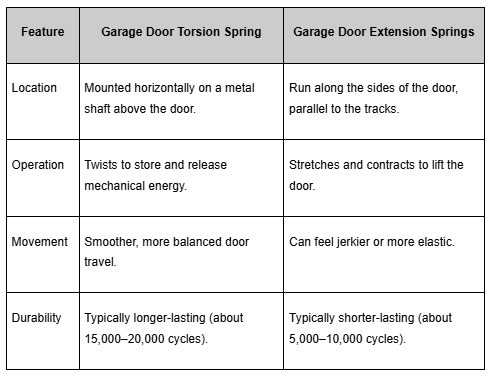
Residential garage doors typically rely on torsion springs or extension springs, and they manage the door’s weight in two very different ways. A garage door torsion spring sits horizontally above the opening on a metal shaft, storing energy by twisting as the door closes and releasing that energy to lift the door as it opens. Because torsion springs control force through rotation under high tension, they tend to deliver steadier, more controlled movement during operation.
Garage door extension springs, on the other hand, are mounted along both sides of the door near the horizontal tracks. Instead of twisting, they stretch as the door closes to store energy, then contract as the door opens to help pull the door upward. That stretching action can create a more elastic feel in the system, which is why extension springs may produce a bouncier or less stable motion compared with torsion setups. The difference in location and mechanics also explains why spring adjustment is not the same process across both systems.
Choosing between torsion and extension springs usually comes down to the door’s weight, design, and the performance characteristics you want over time, since each system brings its own strengths and limits.
Adjusting Garage Door Springs and Their Effect on Door Movement
Garage door spring adjustment is a precise balancing act, since even slight changes in tension can noticeably alter how the door moves. Professionals approach the job in small, controlled increments, increasing or easing tension until the springs properly counter the door’s weight. The method varies by spring type. Torsion systems are adjusted through controlled winding at the shaft, while extension systems are adjusted by shifting how the spring’s stretch is set against the track assembly, because each design stores and releases energy in a different way.
When tension is dialed in correctly, the door stops feeling either stubbornly heavy or overly eager to fly upward. Movement becomes smooth and predictable, the door can rest in place when opened halfway, and the opener no longer has to fight against an unbalanced load, which is the same balance a proper garage door installation is meant to achieve from day one. As springs age and tension naturally fades, the door starts to feel heavier and the system works harder than it should, which is why restoring the right balance through adjustment can bring performance back to normal before strain spreads to other components.
- Increased tension: makes the door feel lighter and reduces the effort needed to lift it.
- Decreased tension: prevents the door from rising too quickly or staying open when it should settle.
- Balanced tension: allows the door to stay in place when opened halfway instead of drifting up or down.
- Reduced strain on the system: eases the load on the opener and supports steadier overall operation.
Warning Signs That Point to Garage Door Spring Repair or a Broken Garage Door Spring
Not every garage door issue signals a major failure, because some can be resolved with a straightforward adjustment, yet others point to something more serious happening inside the system. When spring tension has shifted too far or a component has started to give out, garage door spring repair or even full replacement may be necessary, especially when the spring is near failure. A broken spring sits at the top of that risk list, since it can stop the door from working altogether while creating a safety hazard at the same time.
A loud, sudden bang coming from the garage is one of the clearest signs that a spring has snapped. That sound is the tension releasing in an instant, because springs operate under immense stored force. When the spring breaks, the door often becomes stuck or refuses to open, since the counterbalance that normally carries the door’s weight is no longer there.
These signals shouldn’t be brushed off, because a failed spring can allow the door to drop unexpectedly and cause serious injury to anyone nearby. Visual clues tend to confirm what the door is already telling you: a visible gap running through the torsion spring, or extension springs that appear slack or hang down along the sides. Once those signs show up, the problem has moved beyond a quick adjustment, making professional garage door service the safest way to restore proper operation.
You can explore the earliest balance warnings in “Garage Door Spring Adjustment: The First Signs Your Door Is Losing Balance.”
Early Balance Changes That Often Lead to Garage Door Spring Repair
Long before a spring breaks completely, the door usually starts showing subtle balance issues that reveal tension is drifting out of range. The first clue often comes from how the door behaves mid-travel: when lifted halfway, it should hold its position, and when it drifts down or pulls upward on its own, the springs are no longer matching the door’s weight the way they should.
Another early sign appears when the door rises or closes unevenly, leaving one side higher than the other as it moves through the tracks. That tilt typically means one spring has weakened faster or lost more tension than its partner, which can quietly load extra stress onto the rest of the system. As that imbalance continues, strain can spread into the tracks, cables, and panels, making a spring problem the starting point for broader damage.
Signs that commonly indicate spring repair rather than a minor adjustment include:
- The door feels noticeably heavier to lift by hand than it used to.
- The door won’t stay at the same height when fully opened.
- The door travels unevenly or looks misaligned in the tracks.
- The balance feels inconsistent, even after prior adjustments.
Noises and Door Behavior That Signal a Broken Garage Door Spring
When a garage door spring breaks, the change is usually immediate and obvious, starting with a sharp bang that sounds like a firecracker going off. That noise happens because the spring releases its stored energy all at once, and right after that release, the door often stops functioning normally. If the spring fails while the door is closed, lifting it by hand can feel nearly impossible, since the full weight of the door is no longer being counterbalanced.
Opener behavior adds another layer of confirmation, because the motor isn’t built to carry that weight by itself. The opener may strain, lift the door only a few inches, and then reverse as safety systems detect resistance, which happens because the springs aren’t there to share the load, and a garage door tune-up would typically catch that imbalance early. With extension-spring setups, the door may also appear crooked if one spring has failed while the other is still pulling.
A broken spring tends to announce itself in a single, sudden event rather than a slow chorus of squeaks or grinding, which are more typical of rollers or track issues. Signs most closely tied to a broken spring include:
- A loud, sharp bang from the garage area.
- The garage door suddenly feels extremely heavy to lift.
- The opener strains and cannot raise the door beyond a few inches.
- A noticeable gap appears in the middle of a torsion spring.
When Garage Door Spring Replacement Is the Real Fix, Not Just an Adjustment
At some point, a garage door spring reaches a stage where adjustment can’t restore what’s been lost. When a spring snaps at the end of its service life, replacement becomes the only real solution, because a broken spring cannot hold tension or recover its ability to counterbalance the door. With that support gone, the door’s weight is left unmanaged, which makes operation unsafe while often bringing movement to a stop.
Continuing to run the door with a broken spring puts the rest of the system under stress, even if the opener still has power. Panels can flex, tracks can shift, and the opener can strain against a load it was never meant to carry, since the springs are the components designed to handle that force. Because replacement involves working with high-tension hardware, the safest response to a confirmed break or a door that suddenly won’t lift is to contact a garage door professional for spring replacement.
For a deeper look at sound and motion warnings, read “Garage Door Spring Adjustment: What Unusual Noises and Jerky Movement Usually Mean.”
Symptoms That Typically Require Garage Door Spring Replacement
The clearest signal that replacement is needed is visible spring failure. With a garage door torsion spring, which often shows up as a gap of several inches between coils, and with garage door extension springs, it can look like one side has gone slack or dropped lower than it should. Damage like this means the spring can no longer store or release the energy required to lift the door, which is why adjustment alone won’t solve the problem.
A door that feels dramatically heavier is another strong indicator. When the opener struggles but the door barely rises, and lifting by hand feels nearly impossible, the spring is no longer providing any counterbalance, which is when a broken spring replacement becomes necessary. That’s different from a door that’s simply out of balance, because an off-balance door usually still moves, even if it feels uneven or slightly heavy. With a broken spring, the door feels stuck because you’re suddenly dealing with the full weight of it without spring support.
Signs that typically point to spring replacement include:
- A visible gap in the torsion spring.
- An extension spring that hangs loose or appears slack on one side.
- A loud pop or bang followed by a door that won’t open.
- The top section of the door is flexing or showing damage from an uneven load.
Garage Door Spring Repair vs Garage Door Spring Replacement: What the Problem Suggests
Choosing between garage door spring repair and garage door spring replacement comes down to how far the problem has progressed, since repair usually fits springs that are still intact but have simply lost tension over time, which can throw the door off balance without meaning the spring has failed. Replacement becomes necessary once the spring is physically broken, badly stretched, or heavily corroded, because springs have a limited cycle life and can’t be restored once they’ve reached that point. In setups that use paired springs, replacing both at the same time is often the safer path for keeping the door evenly balanced, because a newer spring working beside an older one can create uneven tension and a second failure not long after. Knowing whether the symptoms point to tension loss or outright spring failure is what makes the decision clear, which is why the scenarios summarized in the table are useful for guiding the call, even though a professional diagnosis is still the most reliable way to confirm what the system needs.
Understanding how garage door spring adjustments affect balance matters for both safety and reliable operation, especially when you know what signs point to a spring that’s off tension or one that has already broken. Paying attention to those warning signals helps prevent small spring issues from turning into larger system problems later on. It also helps to recognize how extension springs and torsion springs differ, since that context makes it easier to judge when the situation calls for repair and when replacement is the only sensible step. With that awareness and consistent maintenance, the door is far more likely to stay smooth, stable, and safe over time, as long as you respond early to the kinds of changes highlighted throughout this article.
When spring problems go beyond what a simple adjustment can solve, First Responder Garage Doors is ready to step in with the right support to get your door working safely again. Our team understands how quickly spring issues can escalate, so we focus on restoring balance, reliability, and smooth movement before the strain spreads to other parts of the system. If your door is showing warning signs, contact us today or give us a call and schedule a quick service visit.
Frequently Asked Questions
Garage door spring repair is usually needed when the spring shows physical failure rather than simple tension drift. If you notice a visible break, a clear gap between coils, heavy stretching, or widespread rust, the spring is no longer structurally sound and won’t respond to adjustment. When the door suddenly feels far too heavy, or the opener struggles and can’t lift it, the spring has likely lost its working tension, which means repair or replacement is the appropriate next step rather than adjustment.
Adjusting a garage door torsion spring changes tension through controlled winding on the shaft above the door, while adjusting garage door extension springs changes tension by repositioning the spring’s stretch along the track-side hardware. Both methods aim to restore balance, but they rely on different mechanisms because torsion springs store energy by twisting, and extension springs store energy by stretching.
Yes, garage door spring replacement is typically done on both springs when a two-spring system is in place, because both springs have gone through the same usage cycle. When one fails, the other is usually close behind, so replacing both keeps the door balanced and reduces the chance of another failure shortly after.
A broken garage door spring usually makes itself known with a sharp bang, after which the door won’t lift normally either by the opener or by hand. You may notice a clear gap in a torsion spring or a slack extension spring hanging to one side, both of which reflect a sudden loss of stored twisting force, as explained by Boston University. An off-balance door, by contrast, will still move but feels heavier than normal, may drift when left halfway open, or closes faster than it should, because the spring tension has become uneven rather than fully failing.
Yes, the door can keep running when adjusting garage door springs is needed, because tension loss happens gradually before a full break. Even if the system still operates, you’ll often notice uneven travel, extra strain on the opener, or a heavier feel, which signals that balance is slipping despite the spring not being visibly broken.
Spring-related trouble is most often linked to a sudden, single bang or pop, which reflects tension releasing quickly rather than friction building over time. If that sound is followed by the opener laboring or the door refusing to rise, the noise is far more likely tied to garage door spring repair needs than to rollers, tracks, or hinges.
Garage door spring adjustment doesn’t alter the door’s actual weight, but it changes how heavy the door feels by restoring the tension that offsets gravity. When springs weaken, the door feels heavier and moves less smoothly, and when tension is brought back into balance, the door travels more evenly and holds position better mid-lift, because the spring force once again matches the load.
A garage door torsion spring can fail early when stress exceeds what it was built to handle, often because the spring doesn’t match the door’s weight or because corrosion weakens the metal over time. Heavy moisture exposure and consistent high-tension cycling accelerate fatigue, which can shorten the lifespan even if the door appears to operate normally until failure.
When garage door extension springs lose tension, the door can start running unevenly and feel noticeably harder to lift because the counterbalance is no longer consistent on both sides. As that imbalance grows, the door may tilt, drop faster than expected, or move in a jerky way, which puts extra stress on rollers, cables, and tracks while the system struggles to compensate for uneven spring force. For practical upkeep cues and safety-minded maintenance habits, the International Door Association is a solid reference, especially when you want to catch early signs of wear before performance becomes unpredictable.
Garage door spring replacement is required when the spring is broken or structurally compromised, which shows up as a visible gap in a torsion spring, a slack extension spring, or a door that suddenly can’t be lifted. Garage door spring repair fits situations where the spring is still intact, but tension has drifted, because balance can be restored only while the spring can still hold and release energy properly.