

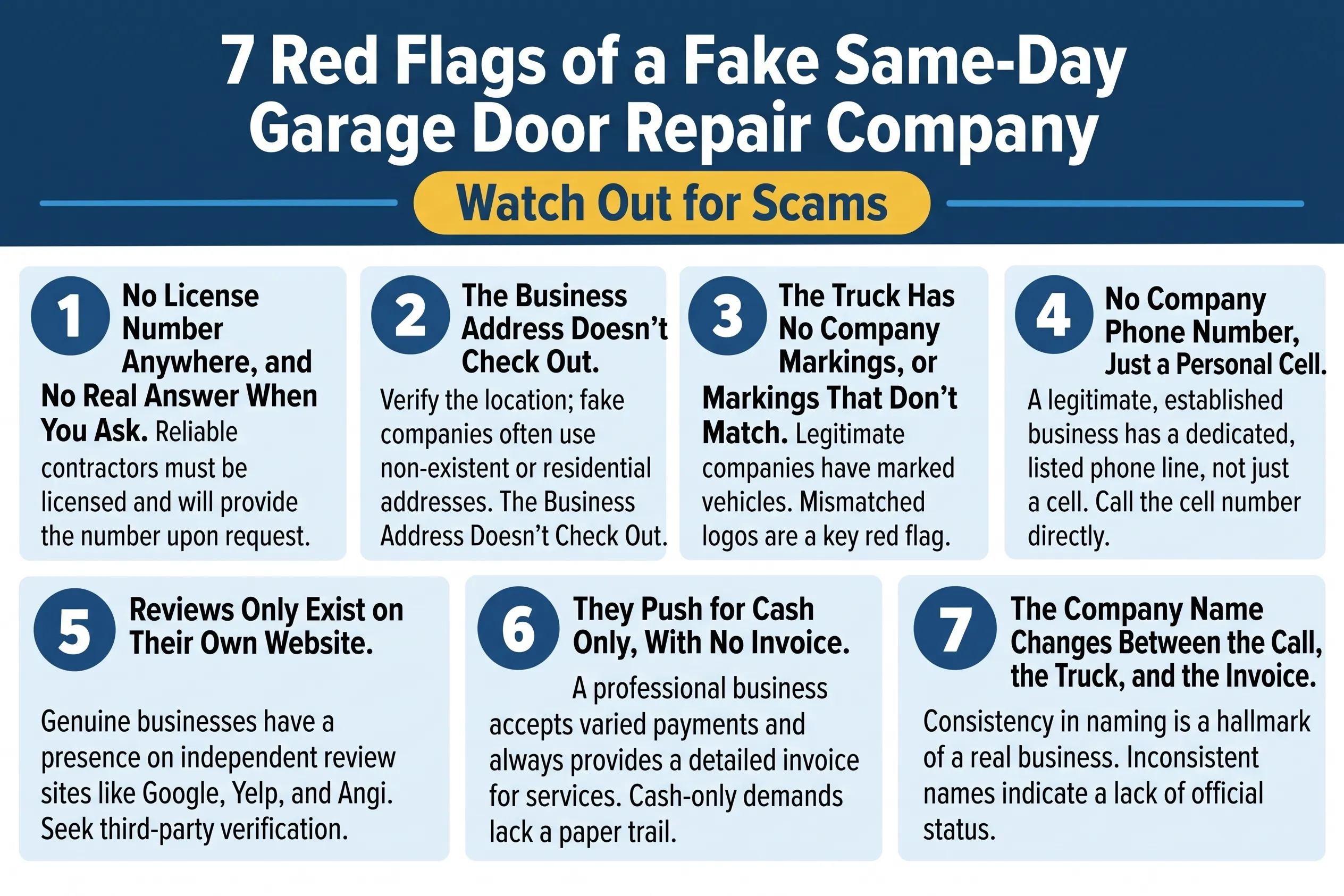
A fake same-day garage door company usually gives itself away before a single tool comes out of the truck. No verifiable license, no real business address, an unmarked vehicle, and a personal cell phone instead of a company line are the clearest signs you’re dealing with an operator who can’t be held accountable if something goes wrong. None of these signs require you to know anything about garage doors, only to ask a few direct questions and notice when the answers don’t add up. A legitimate company welcomes those questions. A fake one deflects them.
Verifying who you’re hiring matters just as much during emergency garage door repair as it does for routine maintenance.
Key Takeaways
- A real license number is checkable. Ask for it before scheduling, not after the technician arrives.
- A business address that doesn’t exist, or belongs to someone else, is one of the fastest ways to spot a fake operation.
- Unmarked trucks and inconsistent company names between the call, the vehicle, and the invoice are common patterns in fraudulent operations.
- Reviews that only appear on a company’s own website, and nowhere else, are worth treating with suspicion.
- A company that pushes for cash with no invoice is protecting itself, not saving you money.
- Verifying a company takes a few minutes before the appointment. Recovering from a fake garage door repair job takes much longer.
Legitimate Company vs. Unlicensed Operation
Signal | Legitimate company | Unlicensed operation |
License number | Provided and checkable against your state’s registry | Refused, vague, or doesn’t match records |
Business address | Real, findable, matches company records | Missing, residential with no business listing, or doesn’t exist |
Vehicle | Marked with company name and logo | Unmarked, or markings don’t match the invoice |
Contact method | Company line answered by a dispatcher | Personal cell phone only |
Online presence | Reviews across multiple platforms, not just their own site | Reviews only exist on their own website |
Payment | Accepts card or check, provides a written invoice | Pushes cash only, resists giving a receipt |
1. No License Number Anywhere, and No Real Answer When You Ask
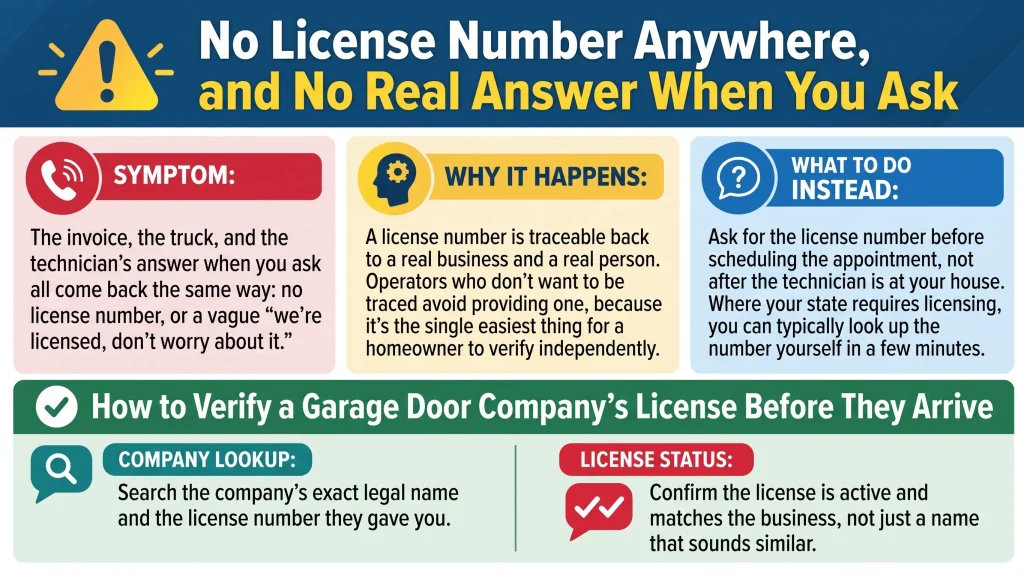
Symptom: The invoice, the truck, and the technician’s answer when you ask all come back the same way: no license number, or a vague “we’re licensed, don’t worry about it.”
Why it happens: A license number is traceable back to a real business and a real person. Operators who don’t want to be traced avoid providing one, because it’s the single easiest thing for a homeowner to verify independently.
What to do instead: Ask for the license number before scheduling the appointment, not after the technician is at your house. Where your state requires licensing, you can typically look up the number yourself in a few minutes.
How to Verify a Garage Door Company’s License Before They Arrive
Most states with licensing requirements maintain a public lookup tool through their contractor licensing board. Search the company’s exact legal name and the license number they gave you, and confirm the license is active and matches the business, not just a name that sounds similar.
2. The Business Address Doesn’t Check Out
Symptom: The address on the invoice or website doesn’t exist, belongs to an unrelated business, or turns out to be a residential property with no business listed there.
Why it happens: A verifiable address means someone can find the company again if a repair fails or a price was inflated. An address that leads nowhere protects the operator, not you.
What to do instead: Search the address before the appointment. A quick map search that shows a real, relevant business at that location is a good sign. A residential home, an empty lot, or an address tied to something unrelated is worth a direct follow-up question.
3. The Truck Has No Company Markings, or Markings That Don’t Match
Symptom: The vehicle that shows up is unmarked, or has a company name and logo that don’t match what was on the invoice, the website, or what the person said on the phone.
Why it happens: A marked, branded vehicle is a visible commitment to a business identity. Operators moving between short-lived business names avoid that commitment, since it’s easier to disappear from an unmarked truck than a branded one.
What to do instead: A few things worth checking against each other:
- Does the name on the truck match the name on the invoice?
- Does either match the name the company gave you on the phone?
- Is there a license or DOT number visible on the vehicle, if your state requires one?
If none of these line up, that mismatch is the answer.
4. No Company Phone Number, Just a Personal Cell
Symptom: Every call, before and after the appointment, goes to the same personal cell phone, with no dispatcher, no company line, and no way to reach anyone else if that number stops answering.
Why it happens: A company with a real office and staff has a way to route calls even if one person is unavailable. A single personal number, answered by the same one person doing the estimating, the repair, and the invoicing, is often a sign of a one-person, short-term operation rather than an established business.
What to do instead: Ask if there’s a company line separate from the technician’s personal number. If you want a general sense of what a properly staffed, reliable garage door service actually looks like, it’s worth comparing against what you’re being offered.
5. Reviews Only Exist on Their Own Website
Symptom: The company’s website is full of five-star testimonials, but a search on Google, Yelp, or the Better Business Bureau turns up little or nothing, sometimes not even a listing.
Why it happens: Reviews on a company’s own site are easy to write and impossible to verify. Reviews on independent platforms are harder to fake and easier for other homeowners to check.
How to Spot Fake Reviews for a Garage Door Company
Look for reviews with specific, varied details, mentioning a technician’s name, a particular repair, or a timeframe, spread across more than one platform. A wall of generic five-star praise that exists only on the company’s own site, with no matching presence anywhere independent, is a pattern worth treating carefully.
If you’re comparing your own experience against a scare-tactic sales call, read 6 Signs a Same-Day Emergency Garage Door Quote Is a Scare Tactic for the language patterns that often show up together with these identity red flags.
6. They Push for Cash Only, With No Invoice
Symptom: Payment is requested in cash, often before work even begins, with resistance to providing a written invoice or receipt afterward.
Why it happens: Cash with no paper trail is nearly impossible to dispute later. There’s no record of what was promised, what was charged, or who did the work.
What to do instead: Insist on a written invoice regardless of payment method, and be cautious of any company that treats that request as unusual. A legitimate business provides documentation as a matter of course, not as a favor.
Call a pro if: you’re already mid-appointment and this comes up. It’s reasonable to pause and ask for the invoice before paying anything, even after work has started.
7. The Company Name Changes Between the Call, the Truck, and the Invoice
Symptom: The name you were given on the phone doesn’t match what’s on the truck, and neither matches what ends up on the final invoice.
Why it happens: Operators who move between business names, sometimes to avoid bad reviews or past complaints attached to an old name, rely on homeowners not noticing the inconsistency until after the work is done. If you also felt rushed into a price that jumped once the technician arrived, read 5 Signs of a Bait-and-Switch Garage Door Repair Quote, since the two patterns frequently overlap.
What to do instead: Write down the name you’re given on the phone before the appointment, and compare it against the truck and the final paperwork. A mismatch, even a small one, is worth asking about directly before you pay.
The International Door Association’s scam awareness resource specifically recommends verifying credentials and reporting fraudulent businesses when these patterns show up, since identity red flags like these are consistently linked to the same-day pressure tactics documented across the industry.
If you want to see how these identity red flags connect to the broader pressure tactics used during same-day calls, read How Scammers Use Same-Day Service as a Pressure Tactic. Being able to answer a few direct questions about licensing, address, and business identity is one of the simplest ways to filter out an unaccountable operator before they ever step into your garage.
Know Who You’re Letting Into Your Garage
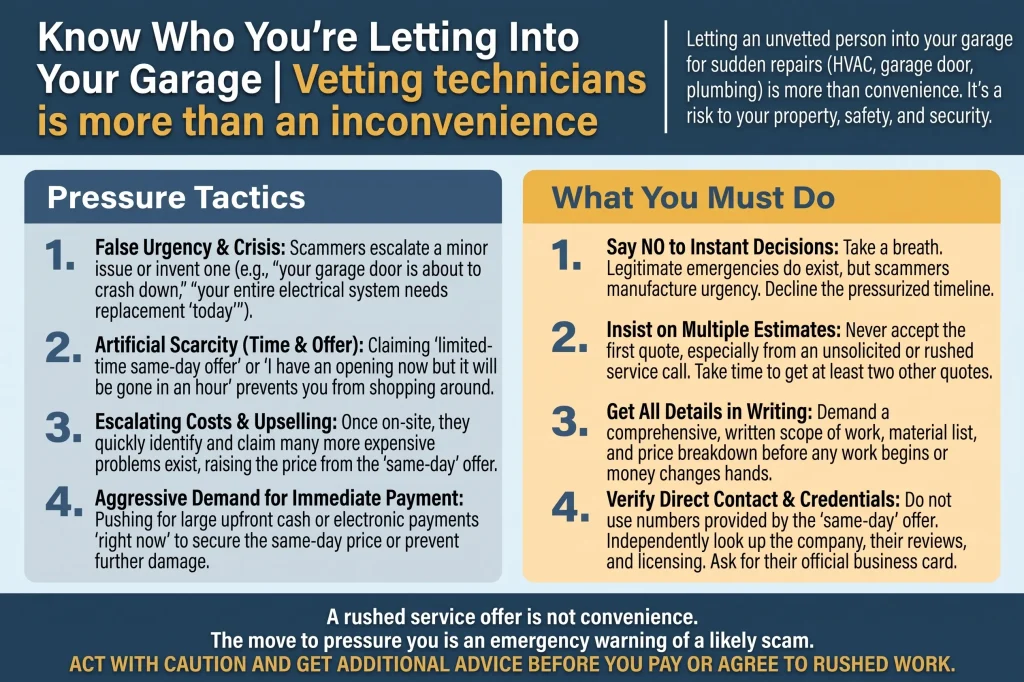
None of these seven signs require special knowledge about garage doors. They’re identity questions, not mechanical ones: does this company exist where they say they exist, can I verify who they are, and will they still be reachable if something goes wrong. A legitimate company answers all three without hesitation.
First Responder Garage Doors is a licensed, local business serving Southlake-area homeowners, with a real address, a company line, and technicians you can verify before they ever arrive. Contact us or give us a call if you want to confirm our credentials before booking.