

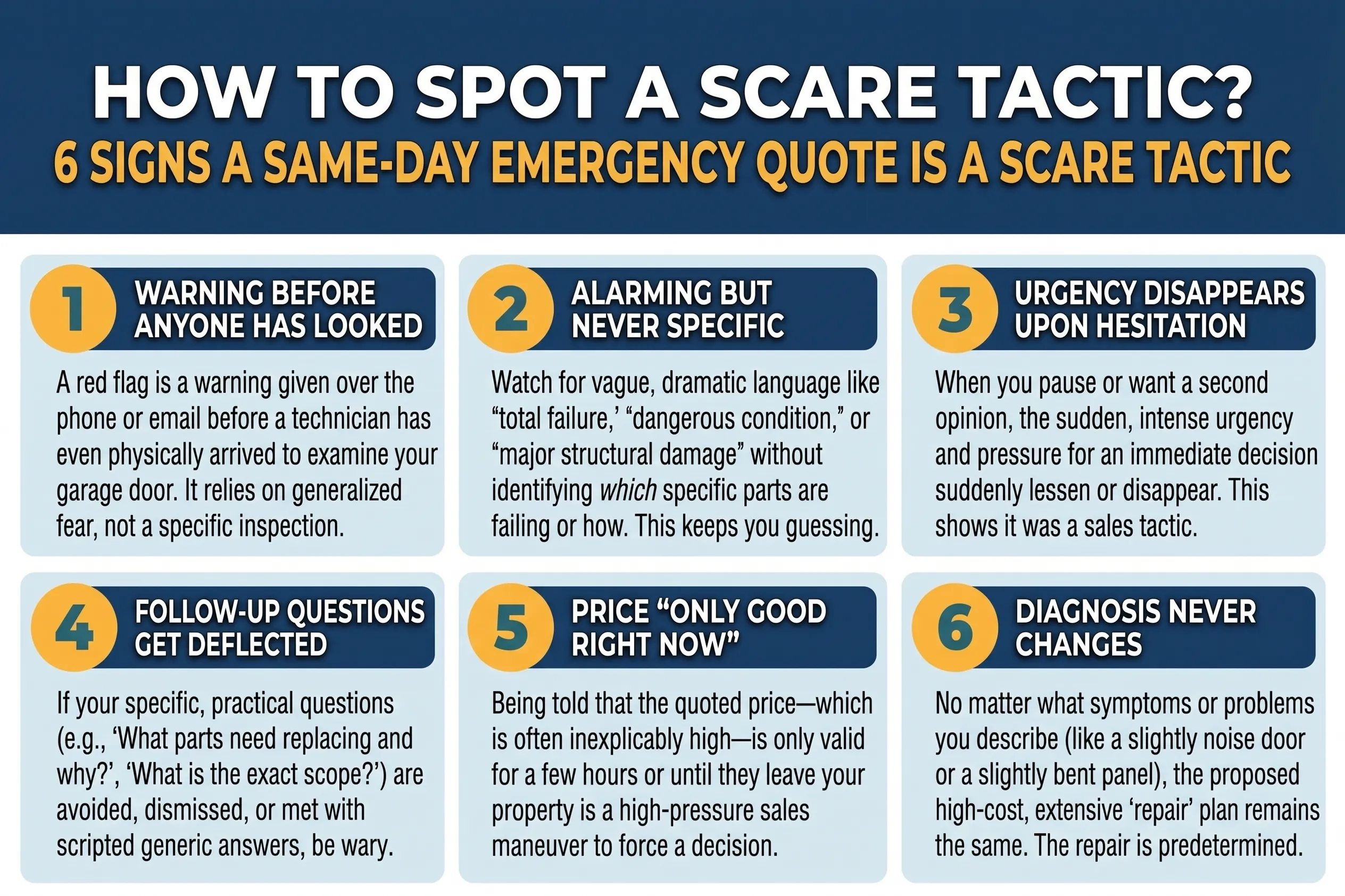
A same-day emergency quote is a scare tactic when the urgency relies on vague language and pressure instead of a real diagnosis, not simply because the door is broken. Legitimate technicians can name the specific mechanical issue, hold the same price whether you book in five minutes or five hours, and answer follow-up questions directly. If the “emergency” language shows up before anyone has looked at your door, if the price is only good for the next few minutes, or if a question gets brushed aside, you’re listening to a script, not a diagnosis.
Not every urgent call is dishonest. Real emergency garage door repair needs happen every day; the difference is how the urgency is delivered, not whether it exists at all.
Key Takeaways
- A real emergency claim comes with a specific mechanical explanation, not just alarming language.
- Scare-tactic scripts lean on words like “unsafe,” “about to fail,” or “dangerous” without detail.
- Legitimate quotes hold steady whether you book now or in an hour.
- A company that won’t let you finish a question is running a script, not helping you.
- Asking “what specifically is wrong?” is the fastest way to separate a real diagnosis from a scare tactic.
- If you feel talked into fear rather than informed, pause before agreeing to any garage door repair on the spot.
Real Emergency vs. Scare-Tactic Quote
Signal | Real emergency | Scare-tactic quote |
When the warning happens | After you describe your door’s symptoms | Almost immediately, before real details are shared |
What triggers the urgency | A specific mechanical issue you described | The caller’s script, not your door |
How it reacts to hesitation | Recommendation stays the same | Urgency shifts, softens, or escalates |
Response to “how do you know?” | Explains the reasoning in plain terms | Repeats the same alarming phrase |
How the price is delivered | Written, holds for a few hours | Verbal, expires in minutes |
Overall tone | Calm, matter-of-fact | Urgent, alarmed |
1. The Warning Comes Before Anyone Has Looked at the Door
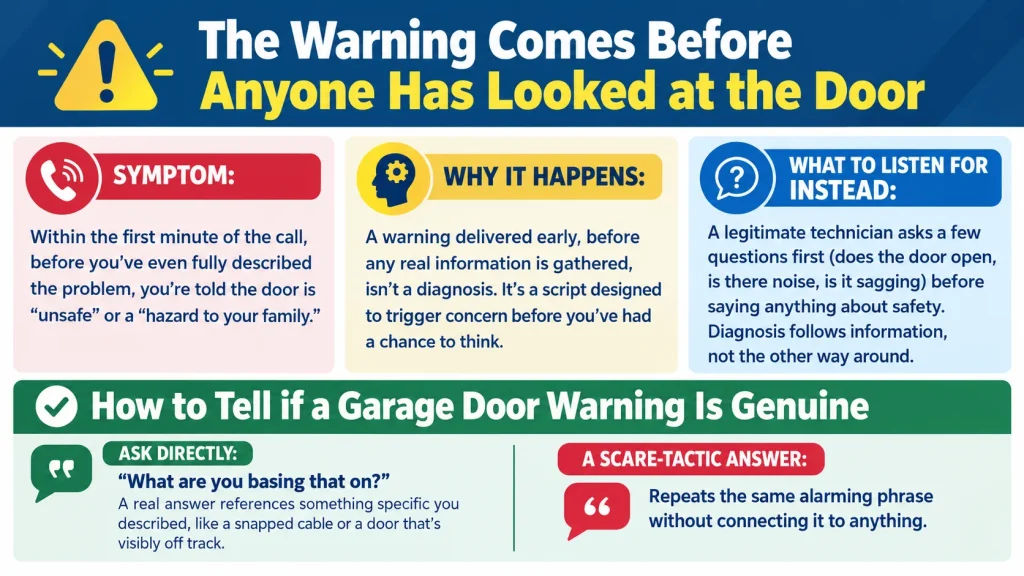
Symptom: Within the first minute of the call, before you’ve even fully described the problem, you’re told the door is “unsafe” or “a hazard to your family.”
Why it happens: A warning delivered early, before any real information is gathered, isn’t a diagnosis. It’s a script designed to trigger concern before you’ve had a chance to think.
What to listen for instead: A legitimate technician asks a few questions first (does the door open, is there noise, is it sagging) before saying anything about safety. Diagnosis follows information, not the other way around.
How to Tell if a Garage Door Warning Is Genuine
Ask directly: “What are you basing that on?” A real answer references something specific you described, like a snapped cable or a door that’s visibly off track. A scare-tactic answer repeats the same alarming phrase without connecting it to anything you said. For the full breakdown of how these pressure tactics work across a same-day call, read How Scammers Use Same-Day Service as a Pressure Tactic.
2. The Language Is Alarming but Never Specific
Symptom: Words like “dangerous,” “about to fail,” or “could hurt someone” come up repeatedly, but no one ever names a part, a mechanism, or a reason.
Why it happens: Specific language can be checked against reality. Vague language can’t. Staying vague protects the caller from being asked a follow-up question they can’t answer, and it works on most people, because fear doesn’t require detail to feel convincing.
What to listen for instead: A short list of what a real explanation sounds like:
- “Your torsion spring looks like it’s lost tension.”
- “One of your cables has frayed near the drum.”
- “The bottom bracket is bent, which is pulling the door off track.”
If every answer stays at the level of “it’s just not safe,” with no part, mechanism, or symptom attached to it, that’s the tell.
3. The Urgency Disappears the Moment You Hesitate
Symptom: You say you want to think it over or call another company, and the tone shifts, either the urgency quietly drops or the caller pushes harder.
Why it happens: If the danger were real, it wouldn’t change based on your willingness to book immediately. A scare tactic is calibrated to your response, not to the door. The moment you push back, the caller has to choose between holding the pressure (risking that you hang up) or backing off (which reveals the urgency was negotiable all along).
What to listen for instead: Watch what happens to the “emergency” framing when you say you need a minute. A real technician will still recommend timely service, since a genuinely broken spring or off-track door is worth addressing soon, but they won’t suddenly downplay the urgency just because you asked for time. If the story changes shape depending on your answer, the original urgency wasn’t about your door at all.
4. Follow-Up Questions Get Deflected or Repeated
Symptom: You ask a direct question, like “how do you know without seeing it?” and get a repeated version of the original warning instead of an actual answer.
Why it happens: Scripts are built to move forward, not to answer questions. A caller working from a script often doesn’t have the technical background to improvise a real answer.
What to listen for instead: A legitimate technician can explain their reasoning in plain terms, even over the phone, because they’re describing something mechanical they’ve seen before, not reciting a line.
How to Spot a Same-Day Garage Door Script vs. a Real Diagnosis
A script sounds the same no matter what you tell them. A real diagnosis changes based on what you describe: a noisy door gets a different explanation than a door that won’t open at all. If the explanation doesn’t shift when your symptoms do, you’re likely talking to a script, and that same evasiveness is often a sign the company itself won’t hold up to scrutiny either.
If a technician deflects licensing or identity questions the same way they deflect diagnostic ones, read 7 Red Flags of a Fake Same-Day Garage Door Repair Company.
5. The Price Is “Only Good Right Now”
Symptom: You’re quoted a number, and told it’s only valid if you agree in the next few minutes, or that the price goes up if you wait until later in the day.
Why it happens: A price that expires in minutes removes your ability to compare it against anything else. It’s designed to be accepted before you can think, the same way a limited-time sale pushes a purchase decision before you’ve had time to look elsewhere.
What to listen for instead: Ask for the quote in writing before deciding anything. If the offer genuinely disappears the moment you ask for that, it likely wasn’t a real offer to begin with. Real same-day work can carry a modest premium for last-minute scheduling, since it means a technician is rearranging their day for you, but that premium doesn’t need a countdown attached to it. A written quote should hold for at least a few hours, long enough for you to make a call if you want one.
6. The Diagnosis Never Changes, No Matter What You Describe
Symptom: Whether you describe a noisy door, a slow door, or a door that won’t open at all, you get roughly the same answer: it’s dangerous, and it needs to be fixed today.
Why it happens: A one-size-fits-all diagnosis is easier to deliver over the phone than an accurate one, especially if the goal is booking the visit rather than solving the specific problem you actually have. It also means the caller doesn’t need real technical knowledge, just a script that sounds urgent no matter what you say.
What to listen for instead: Your actual symptoms should shape the conversation. A slow or noisy door and a door that’s completely stuck are different problems with different levels of urgency, and a real technician will treat them differently.
If you want a closer look at how these same patterns show up in pricing specifically, read 5 Signs of a Bait-and-Switch Garage Door Repair Quote.
If you’re not sure what’s actually wrong with your door before you even pick up the phone, our guide on common signs your garage door needs a professional is a good place to start.
Garage door emergencies are real, and the International Door Association’s scam awareness resource notes that dishonest operators specifically target homeowners during moments of urgency, when they’re least likely to slow down and compare. Recognizing a scare-tactic script doesn’t mean ignoring a genuine problem. It means separating the real mechanical issue from the sales pressure wrapped around it.
Trust the Diagnosis, Not the Pressure
.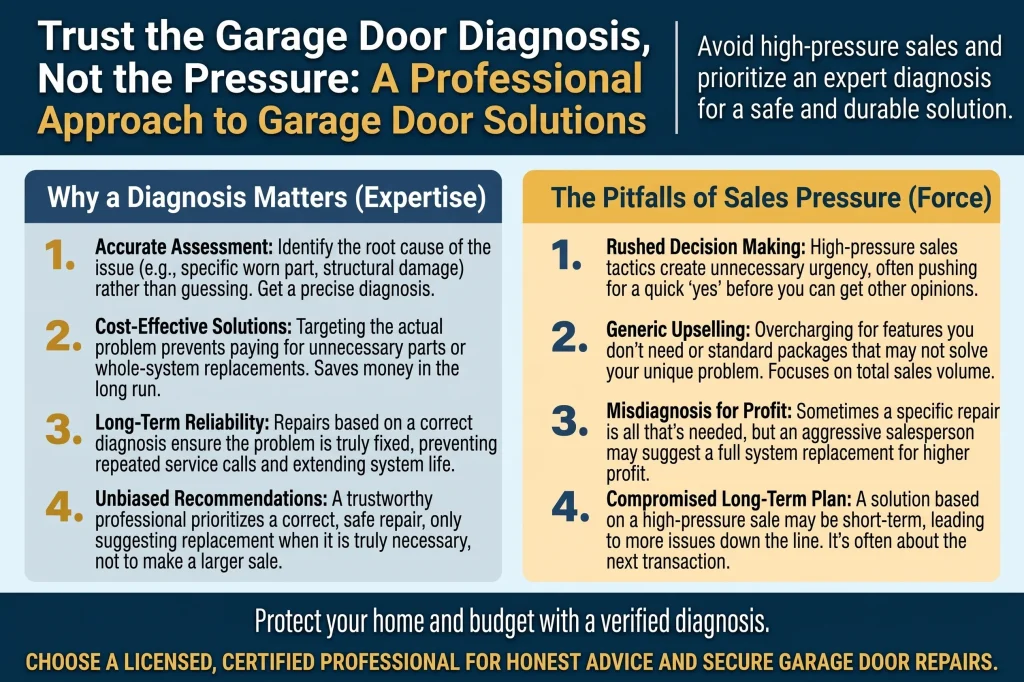
A door that won’t open, a spring that’s let go, or a cable that’s snapped are real problems worth calling about quickly. What shouldn’t change is your ability to ask a question, hear a specific answer, and take a minute to think before agreeing to anything. If the urgency depends on how fast you say yes rather than on what’s actually wrong with your door, that’s the scare tactic showing itself, not the emergency.
First Responder Garage Doors diagnoses Southlake-area garage doors based on what’s actually happening with your door, not a script, and our licensed technicians will explain exactly what they’re seeing before you decide on anything. Contact us or give us a call if you want a second opinion on a quote that felt rushed.