

Not every garage door opener fits every home. What works perfectly in one setup can be completely wrong for another. When it comes to side mount garage door openers, the decision is less about preference and more about whether your garage is properly set up to support one. In many cases, underlying issues that typically require garage door repair, such as an unbalanced door or worn spring system, also play a role in whether this type of opener will perform as expected.
The good news is that the answer is not complicated once you know what to look for. This guide walks you through the honest questions every homeowner should ask before committing to a side mount opener, so you can move forward with confidence rather than guesswork.
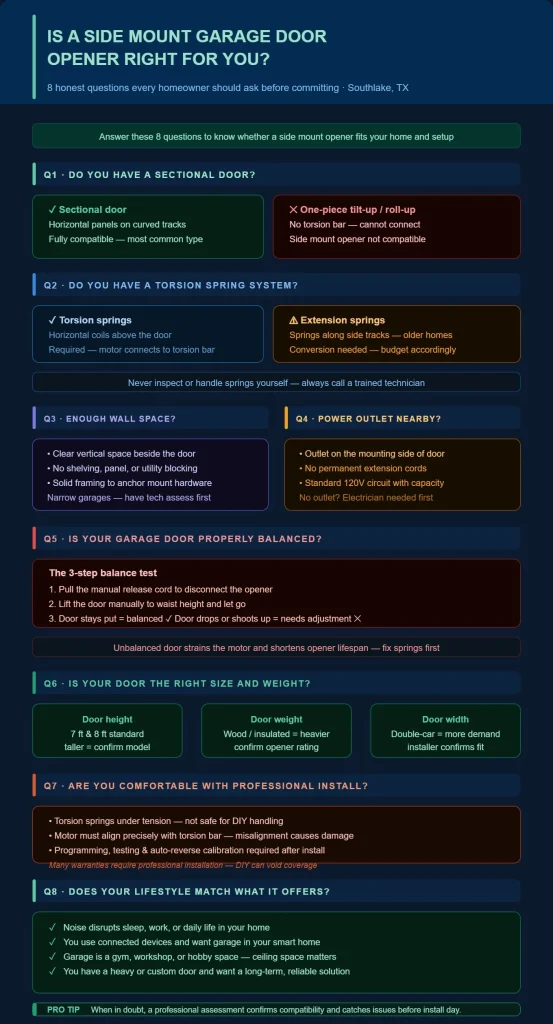
Does Your Garage Have a Sectional Door?
This is the first question any technician will ask, and for good reason. Side mount openers are only compatible with sectional garage doors, which are the kind that open in horizontal panels that roll up along a track.
Here is a quick way to figure out what you have:
- Sectional door. The door is made up of several horizontal panels connected by hinges. When it opens, the panels separate slightly and travel up along curved tracks on either side of the opening. This is the most common residential garage door type and is fully compatible with a side mount opener.
- One-piece tilt-up door. This style swings outward from the bottom as a single solid panel before tilting up into the garage ceiling. It does not use a torsion bar system, which means a side mount opener cannot connect to it.
- Roll-up door. Common in commercial settings, this style coils around a drum above the opening. Residential versions exist but are less common, and compatibility with a side mount opener depends on the specific setup.
If you are not sure which door type you have, a quick visual inspection of the door panels and track system will usually tell you. A professional can confirm during an assessment.
If you want to understand what makes this opener different from a ceiling-mounted model, read What Is a Side Mount Garage Door Opener?
Does Your Garage Use a Torsion Spring System?
After confirming your door type, the next thing to check is your spring system. Side mount openers work by connecting the motor directly to the torsion bar, which is the horizontal metal bar that sits above the garage door and controls the spring tension that helps the door move.
Here is how to tell which system you have:
- Torsion springs. These are coiled springs mounted horizontally above the garage door, running along the torsion bar. They are the most common type in newer residential garages and are required for a side mount opener to work.
- Extension springs. These run along the horizontal tracks on either side of the door and stretch to create tension. They are common in older homes and are not directly compatible with a side mount opener without a conversion.
Important note: Do not attempt to inspect or handle torsion or extension springs on your own. Both types are under significant tension and require a trained technician to assess safely. If you are unsure which system you have, schedule a professional inspection before making any decisions.
If your garage currently uses extension springs, a conversion to a torsion spring system is possible, but it is an additional step that should factor into your planning and budget.
Is There Enough Wall Space Beside Your Garage Door?
A side mount opener needs a clear, sturdy section of wall on one side of the garage door for the motor unit to be mounted properly. This sounds straightforward, but it is worth checking carefully before assuming the space is available.
Here is what to look for:
- Sufficient vertical wall space. The motor unit needs to be mounted at a specific height beside the door. Check that there is no shelving, electrical panel, utility hookup, or structural element blocking that area on either side.
- A solid wall surface. The unit needs to be anchored into solid framing, not just drywall. A technician will locate the studs and confirm that the wall can support the mounting hardware properly.
- Clearance from the door track. The motor connects to the torsion bar, but the mounting bracket also needs to sit close enough to the bar without interfering with the door track hardware on that side.
In most standard two-car garages, wall space is not an issue. In narrower single-car garages or garages with a lot of built-in storage along the walls, it is worth having a technician take a look before assuming the installation is straightforward.
To get a full picture of what makes this opener type a smart upgrade, Why a Side Mount Opener Is Worth Every Penny walks through the practical and long-term value in detail.
Is There a Power Outlet Near the Mounting Location?
A side mount opener needs a standard electrical outlet close to the wall-mount location to power the unit. This is something many homeowners overlook until installation day.
Here is what to think through:
- Check both sides of the door. Outlets near garage doors are not always in the most convenient spots. Confirm whether an outlet exists on the side where the opener will be mounted.
- Avoid relying on extension cords. Running a garage door opener on a permanent extension cord is not a safe long-term solution. If an outlet is not in the right location, a licensed electrician should install one before the opener goes in.
- Check the circuit capacity. Most side mount openers run on a standard 120-volt circuit, but it is worth confirming that the existing circuit can handle the load without tripping the breaker, especially if other garage equipment shares the same circuit.
If electrical work is needed, factor that into your timeline and budget before scheduling garage door installation. Your installer can advise on this during the initial assessment.
Is Your Garage Door Properly Balanced?
This one matters more than most homeowners realize. A side mount opener, like any garage door opener, is designed to assist a properly balanced door. It is not designed to compensate for a door that is out of balance.
Here is a simple way to check your door balance:
- Disconnect the opener by pulling the manual release cord.
- Manually lift the door to about waist height and let go.
- A properly balanced door will stay in place or move only slightly. A door that drops quickly or shoots upward is out of balance.
If your door fails this test, the spring tension needs to be adjusted before a new opener is installed. Operating a side mount opener on an unbalanced door puts unnecessary strain on the motor and can significantly shorten its lifespan.
Routine garage door maintenance also helps identify balance problems early, since uneven movement, extra strain, and unusual noise are often warning signs that the system needs attention.
Pro tip: Never attempt to adjust spring tension yourself. This is one of the most common causes of serious garage door injuries and should always be handled by a trained technician.
Do You Have the Right Door Size and Weight?
Side mount openers are built to handle a range of door sizes and weights, but confirming compatibility with your specific door is an important step before installation.
Here is what affects compatibility:
- Door height. Most side mount openers are rated for standard 7-foot and 8-foot residential doors. Taller custom doors may require a specific model or additional hardware.
- Door weight. Heavier doors, such as solid wood, carriage-style, or heavily insulated models, require an opener rated for the load. Most side mount openers handle these well, but the specific rating should be confirmed against your door’s weight.
- Door width. Wider doors, including double-car doors, put more demand on the opener and spring system. Your installer will confirm whether any adjustments are needed to support the wider span.
A quick measurement of your door and a check of the product specifications will tell you whether a standard model is sufficient or whether a higher-capacity unit is needed.
Are You Comfortable With a Professional Installation?
This is a practical question that matters. A side mount opener is not a DIY project for most homeowners, and attempting to install one without the right training and tools creates real safety risks.
Here is why professional installation is the right call:
- Torsion springs are involved. Connecting and calibrating the opener to the torsion bar requires working near components that are under significant mechanical tension. This is not a task for someone without proper training.
- Alignment matters. The motor must be precisely aligned with the torsion bar for the system to operate correctly. Misalignment causes premature wear and can damage both the opener and the door.
- Programming and testing require expertise. After installation, the opener needs to be programmed, tested through multiple cycles, and calibrated for proper auto-reverse sensitivity. A trained technician does this as part of the standard installation process.
- Warranties often require professional installation. Many opener manufacturers require proof of professional installation to honor the product warranty. A DIY install can void coverage that you paid for.
The cost of professional installation is a reasonable part of the overall investment, and it ensures the system is set up correctly from day one.
Does Your Lifestyle Match What a Side Mount Opener Offers?
Beyond the technical requirements, the right opener is also the one that fits how you actually use your garage and your home. It should match your priorities for convenience, noise level, maintenance, and long-term reliability. For homeowners who already stay on top of routine care like a garage door tune-up, a side mount opener can be an especially practical upgrade because it is designed for smooth operation and easier ongoing maintenance.
Here is an honest look at who this opener suits best:
- You value quiet operation. If noise from the garage disrupts sleep, work, or daily life in your home, a side mount opener delivers a noticeably quieter experience.
- You want smart home integration. If you are already using connected devices and want your garage door to be part of that ecosystem, modern side mount openers are built for it.
- You use your garage for more than parking. Gyms, workshops, hobby spaces, and home offices in the garage benefit from the freed-up ceiling space a wall-mount opener provides.
- You have a heavier or custom door. If your door is not a standard lightweight model, a side mount opener is typically the more capable and appropriate match.
- You want a long-term solution. If you are tired of recurring repairs and want an opener that is built to last with minimal maintenance demands, this is the right direction.
Many common garage door problems are linked to spring systems, including uneven movement, sudden failure, or difficulty opening and closing.
For homeowners who are still working through the timing of the upgrade, When Should You Switch to a Side Mount Opener? covers the specific signs and situations that signal it is time to make the move.
How to Know If a Side Mount Opener Is the Right Fit
A side mount garage door opener is not the right choice for every garage, but for the homes it suits, it is genuinely one of the best upgrades available. The key is making sure your door type, spring system, wall space, and electrical setup are all compatible before moving forward.
The best way to get a clear answer for your specific situation is to have a professional take a look. A thorough assessment takes the guesswork out of the decision and ensures the installation goes smoothly from start to finish. If you are in Southlake, TX, and ready to find out whether a side mount opener is the right fit for your garage, First Responder Garage Doors is here to help. Contact us or give us a call today for a professional assessment and honest guidance from a team that knows garage doors inside and out.